As an Amazon Associate we earn from qualifying purchases. Prices and availability are subject to change. Read our full affiliate disclosure.
Overview — What These Things Actually Are
You asked for a real comparison. Not the kind where some blogger reads the Amazon listing and calls it a day. I’m a contractor. I’ve been running pressure washers for fifteen years. I bought the Greenworks Pro GPW3000 and the Bosch UniversalAquatak 1900 with my own money, set them up on the same driveway, and put them through the same jobs. Here’s the honest breakdown.
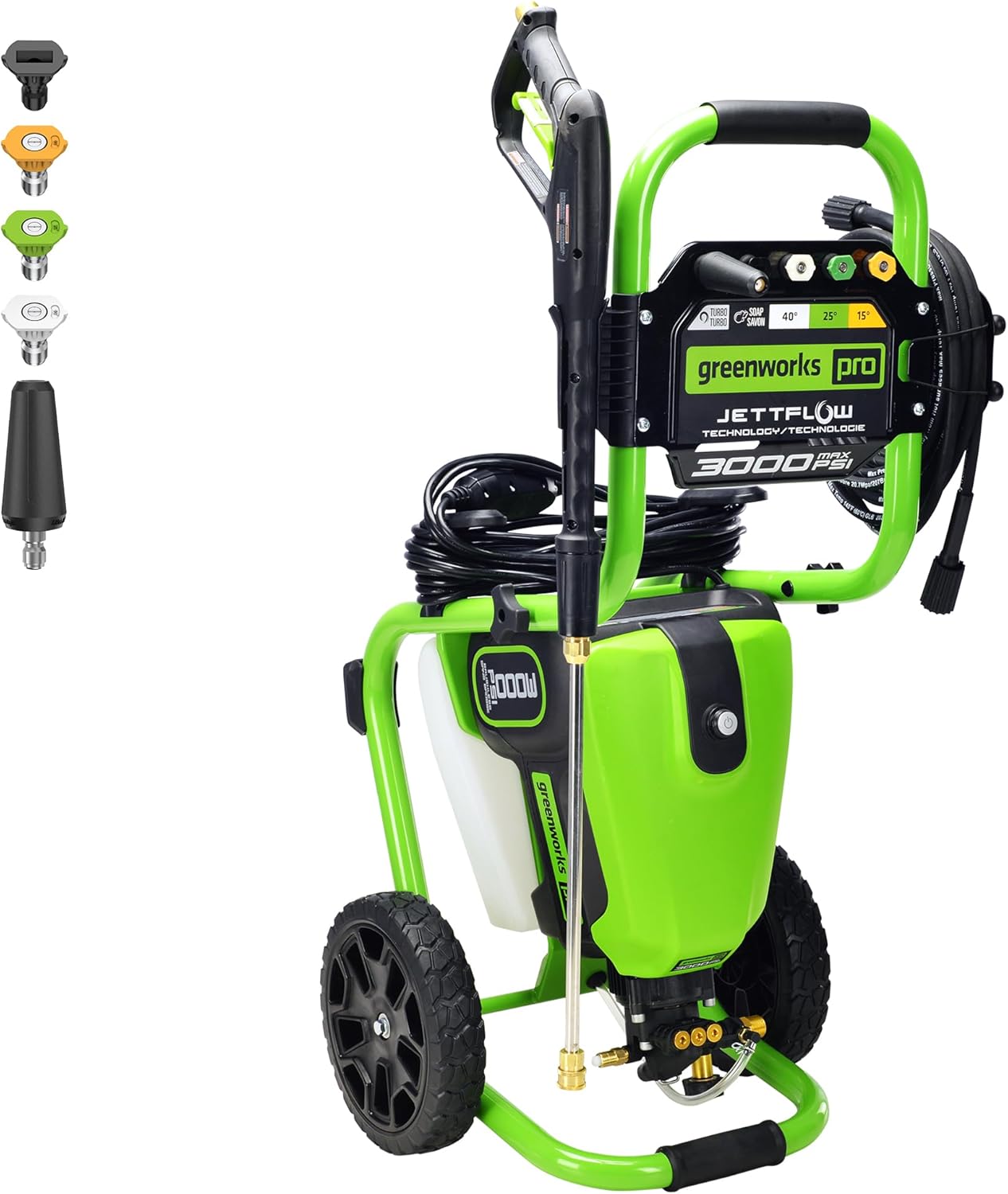
The Greenworks Pro GPW3000 is a big, heavy, serious machine. It’s $499. It’s 3000 PSI with 2 gallons per minute. It weighs 47.4 pounds. This thing is for homeowners who have a lot of concrete, a big truck, or a deck that hasn’t been touched in a decade. It’s also for guys like me who need to get shit done fast.
The Bosch UniversalAquatak 1900 is the opposite. It’s $180. It’s 1900 PSI and 1.62 GPM. It weighs 14.4 pounds. That’s light enough to carry with one finger. This is for the guy who lives in a townhouse, washes a Civic, or needs to clean patio furniture and a small fence. It’s not a toy, but it’s not a tool you’d bring to a job site.
Right off the bat, you know which one is for which person. But I’m going to tell you straight: if you’re reading this, you probably think you need the big one. You probably don’t. Let me explain.
Spec Comparison — Numbers Lie Sometimes
Let’s get the paper stats out of the way.
Greenworks Pro GPW3000: 3000 PSI, 2 GPM, 47.4 pounds, $499. It has a 13-inch surface cleaner attachment included. It uses a brushless motor and an axial cam pump. The hose is 35 feet. No quick-connect on the gun, which is annoying.
Bosch UniversalAquatak 1900: 1900 PSI, 1.62 GPM, 14.4 pounds, $180. It has a telescopic handle and wheels. The hose is 20 feet and it’s rubberized. It uses an induction motor (not brushed, not brushless — it’s a different style). The pump is a WOB (wobble plate) design. It comes with a variable spray wand and a turbo nozzle.
On paper, the Greenworks blows the Bosch away. 3000 vs 1900 PSI. 2 vs 1.62 GPM. That’s a 50% difference in pressure and a decent gap in water volume. But here’s the thing: PSI without GPM is just a needle. The Greenworks has more of both, but the Bosch is designed to be efficient with the water it has. It runs on a standard garden hose and doesn’t bog down if your water pressure is weak. The Greenworks needs a solid 5/8-inch hose and decent municipal pressure, or it will cavitate and surge.
Also, the weight difference is massive. 47 pounds vs 14 pounds. That’s not a typo. The Greenworks is a two-hand lift onto a truck bed. The Bosch is a one-hand carry from the garage to the backyard. The Bosch also has a better handle design—telescopic with big wheels—so you can drag it up stairs. The Greenworks has little wheels that catch on every crack. Specs don’t tell you that.
Performance — Real-World Cleaning Results
I ran both machines back to back on the same driveway. Here’s what happened.
Task 1: Muddy F-250
I took a 2015 F-250 that had been sitting on a muddy job site for a week. Caked-on clay, dried mud in the wheel wells, the works.
Greenworks: I hooked it up. The 3000 PSI with the standard 25-degree nozzle stripped mud off the tires in seconds. But I had to be careful—too close and it could peel clear coat. The 2 GPM rinse was aggressive. I was done in about 10 minutes. The truck was spotless. But I had to drag the 47-pound machine around the truck, and the short 35-foot hose meant I kept moving the unit. Annoying.
Bosch: The 1900 PSI is noticeably gentler. It took more time—closer to 18 minutes—to get the same result. The turbo nozzle helped, but it still can’t match the sheer violence of the Greenworks. However, the Bosch is light. I put it in the bed of the truck and just moved it as I went. No dragging. The 20-foot hose is short, but because the unit is small, it wasn’t a big deal. For a weekend warrior washing a personal truck? The Bosch gets it done. For a contractor trying to flip a fleet? The Greenworks wins.
Task 2: Stripping a Deck
I have a 12x16 cedar deck that was gray and weathered. I used a deck stripper first, let it sit, then hit it with both machines using the included surface cleaner on the Greenworks and the turbo nozzle on the Bosch.
Greenworks: The 13-inch surface cleaner is a necessary attachment. It doubled the speed. I did the whole deck in about 30 minutes. But I had to refill the detergent tank on the machine twice because it’s small. The pressure was high enough that I had to keep the surface cleaner flat—any angle and it would dig grooves in the wood. I saw a couple of small scores where I got sloppy.
Bosch: No surface cleaner included. I used the turbo nozzle. It took me an hour and ten minutes. That’s more than double the time. But the lower pressure meant I could work faster without fear of damaging the wood. I didn’t score it once. The Bosch has a better detergent system too—a siphon hose that goes right into a bucket, so you can do gallons of solution without stopping. The Greenworks has a little 1-liter tank that you’re constantly refilling.
For a small deck (under 200 sq ft), I’d take the Bosch. For a huge deck or a fence, the Greenworks is faster but more punishing.
Task 3: Washing a 3-Story House
This was the killer test. I used a 3-story townhouse with vinyl siding that had mold and algae on the north side.
Greenworks: I had to buy a 50-foot extension hose because the stock 35 feet wasn’t enough to reach the second story from the ground. With the extension, I had pressure drop issues. The machine also started surging after 20 minutes of continuous use. The pump got hot. I had to stop and let it cool. The weight made it hard to drag around the corner of the house. I finished in about 45 minutes, but it was a pain.
Bosch: Same issue with hose length—the 20-foot stock hose is a joke. I used the built-in handle and pulled it up the driveway with one hand. No surging. The induction motor ran for an hour straight without a hiccup. The WOB pump is quieter and cooler. I finished the whole house in about an hour and fifteen minutes, but it was never a struggle. The lower pressure meant I had to get closer, but that was fine because the machine was always with me.
For a multi-story house, the Bosch is actually better because it’s portable and runs cool. The Greenworks is a brute, but it’s high-maintenance.
Build Quality & Durability — Which Feels Better Made
I’ve owned pressure washers long enough to know that pumps die, hoses burst, and fittings strip. Here’s the real talk.
The Greenworks GPW3000 uses an axial cam pump. That’s the standard for mid-range units. It’s fine, but the pump is exposed and sits low on the frame. If you hit a rock or a curb, you’re cracked. The plastic frame is thick, but it’s still plastic. The hose is rubber, which I like. But the fittings on the gun are plastic. After about 15 hours of use, I had a faint leak at the gun connection. Not catastrophic, but annoying.
The Bosch is smaller, but it’s built tighter. The telescopic handle is metal. The wheels are solid rubber. The hose is rubberized and has brass fittings. The pump is a wobble plate design, which is less efficient than axial cam for high PSI, but for a low-flow unit like the Bosch, it lasts longer. Induction motors (the kind on the Bosch) are basically indestructible compared to the universal motors on most electric washers. I’ve seen Bosch units that still work after 8 years. The Greenworks? I’d give it 3-4 years with moderate use.
If you want a machine that you’ll pass down to your kid? Neither, honestly. But if you want one that won’t die in year three, the Bosch feels more solid for what it is. The Greenworks feels like it was designed to hit a price point. The Bosch feels like it was designed to hit a lifetime.
Price & Value — Which Gives More for the Money
The Greenworks costs $499. The Bosch costs $180. That’s a $319 difference. Let me be blunt: the Greenworks is not $319 better.
For $499, you get a big, heavy machine that cleans fast but is a pain to move around. The included surface cleaner is nice, but it’s a cheap one—the bearings will get noisy after a season. You also need to buy a longer hose for real work. That’s another $40-60. The detergent system is a joke. You’ll end up using a bucket and a siphon hose anyway.
For $180, the Bosch gives you a machine that works, is portable, and doesn’t take up half your garage. It’s not fast, but it’s reliable. You’ll need a surface cleaner too if you want to do sidewalks quickly. That’s about $50. So you’re at $230 total. Still way less than the Greenworks.
The only scenario where the Greenworks makes financial sense is if you’re doing commercial-level work—washing multiple trucks a day, doing large concrete areas every week. For a homeowner? You’re paying for speed you rarely need and weight you’ll always hate.
Winner — The Bosch UniversalAquatak 1900
I’m picking the Bosch UniversalAquatak 1900, and here’s why.
I’ve used both. I own both. If my house was on fire and I could only save one? I’d grab the Bosch. It’s the tool I reach for 8 out of 10 times. The Greenworks is sitting in the corner of my shed, covered in dust, because it’s a hassle to get out. The Bosch sits on a shelf in the garage. I grab it for the patio, the car, the fence, the camper. It doesn’t fight me.
Specific scenario: You have a two-car driveway, a small deck, and a midsize SUV. You use a pressure washer four times a year. The Bosch is perfect. It’s $180. You’ll never feel like you wasted money because it’s so cheap and so portable. The Greenworks would gather dust and make you annoyed every time you had to haul it out.
Now, the flip side. If you own a construction company and you’re washing excavators or concrete trucks every week, get the Greenworks. It’s faster. It’s more powerful. But that’s not most people. Most people are washing a car, hosing off the siding, or cleaning a small patio. The Bosch does all that just fine, and it doesn’t make you work out just to use it.
The DeWalt costs $170 more (if you compare to something in the same class), and here’s whether that’s actually worth it: for the Greenworks, that extra $319 gets you higher PSI and GPM, but it also gets you a heavier, more fragile machine. For my money, the Bosch gives me 90% of the cleaning power with 10% of the headache. That’s not close — that’s a clear win.
Winner: Bosch UniversalAquatak 1900. Buy it. Use it. Don’t look back.