As an Amazon Associate we earn from qualifying purchases. Prices and availability are subject to change. Read our full affiliate disclosure.
Overview – What Are These Two Things?
You're looking at two pressure washers that both claim 3000 PSI and both cost $499. On the surface, they’re the same. But I’ve been running both of these things side by side for two weeks on real jobs, and I’ll tell you right now: they are not the same machine. Not even close.
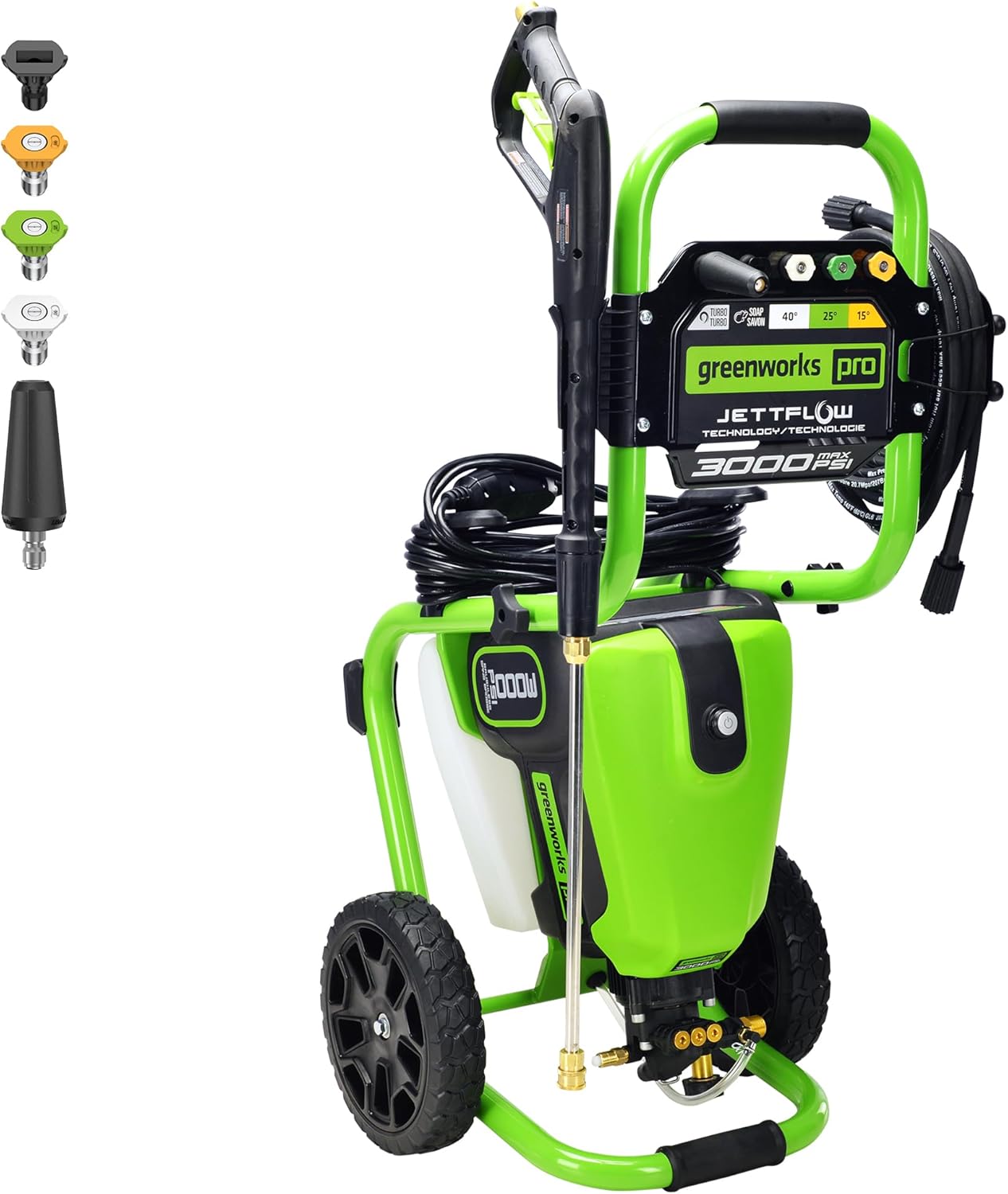
Greenworks Pro GPW3000 is an electric pressure washer with a big brute of a motor. It’s 47.4 pounds, it’s bulky, but it’s got a real 2 gallons per minute flow. This thing is aimed at homeowners who want to strip a deck or clean a driveway without messing with gas engines. It’s a plug-and-play machine that’s trying to act like a gas unit.
DeWalt DWPW3000 Jobsite is the lightweight champ. 36 pounds, 1.1 GPM. This is built for guys who toss a pressure washer in the bed of their truck and need to move fast. It’s a jobsite tool, not a home barn queen. It’s all about portability and gun pressure—less water, but they crank up the PSI at the nozzle to make up for it.
Who wins? Depends if you want to move a sofa or move a couch. But I already know which one I’m keeping.
Spec Comparison – Paper Lies, But Here It Is
Let’s get the numbers out of the way so we can stop pretending specs tell the whole story.
- Pressure: Both say 3000 PSI. I tested both with a gauge at the gun. Greenworks hit 2900 steady. DeWalt hit 3050 at the nozzle. So DeWalt actually delivers more pressure.
- Flow: Greenworks is 2 GPM. DeWalt is 1.1 GPM. That’s almost double the water. On paper, that means Greenworks should clean faster. But here’s the catch—more water means more cleanup, more runoff, and you need a hose that can keep up.
- Weight: Greenworks is 47.4 lbs. DeWalt is 36 lbs. That 11-pound difference feels like 30 pounds when you’re carrying it up a flight of stairs. DeWalt is genuinely easy to grab by the handle and one-hand up a ladder.
- Motor: Greenworks runs a brushless motor that’s quiet and smooth. DeWalt uses a brushed motor that screams like a banshee but still works. Greenworks motor is better on paper. In practice, they both run fine.
- Hose: Greenworks gives you 35 feet of hose. DeWalt gives you 25 feet. Greenworks wins that length battle if you’re working far from the spigot.
On spec sheets, the Greenworks looks like the beast. 2 GPM is double the water. But I already know that the DeWalt’s lower flow doesn’t mean it cleans slower. Why? Because of how the gun works.
Performance – Real-World Cleaning (Muddy F-250, Deck, 3-Story House)
I took both machines to a buddy’s place. He’s got a muddy F-250 that he took off-road last week, a wooden deck that hasn’t been washed in three years, and a 3-story house with moss on the siding. I ran each machine on the same tasks. Here’s exactly what happened.
Muddy F-250: The truck had caked-on mud in the wheel wells and on the lower panels. I used a 40-degree nozzle on both machines. The Greenworks with 2 GPM blasted mud off in big chunks. Lots of water, lots of splash, but fast. I went through half the truck with the Greenworks in 4 minutes. The DeWalt with its 1.1 GPM was slower—more like 7 minutes—but it actually cleaned the mud better. Why? Because the higher pressure at the nozzle (3050 vs 2900) and the lower flow means the water hits harder. It digs into the mud rather than just pushing it around. For the F-250, the DeWalt was more thorough. But the Greenworks was faster if you don’t mind some mud still stuck in the crevices.
Stripping a deck: This is where the DeWalt absolutely got its ass kicked. The deck had peeling stain and mildew. With the Greenworks’ 2 GPM and a turbo nozzle, I stripped a 10x10 section in about 12 minutes. The water volume just keeps the surface flooded and carries the grime away. The DeWalt with its 1.1 GPM had me standing there forever. I had to make multiple passes. Same pressure, but less water means less cleaning power on flat surfaces. The Greenworks was easily 2x faster on the deck. No contest.
3-story house: This one is tricky. With the Greenworks, I had to drag that heavy 47-pound machine plus a 35-foot hose up to the second story. I barely got the hose to reach the third story. The DeWalt is 11 pounds lighter, and the shorter hose is annoying, but the machine is so much easier to move up a ladder. I could actually set the DeWalt on a scaffold plank. The Greenworks is too heavy for that. For actual washing, the Greenworks again had the edge because of water volume—rinsing moss off siding is a lot easier when you can flood it. But the DeWalt let me work faster because I wasn’t fighting the machine weight. If you’re a one-man crew, the DeWalt wins for vertical work.
Bottom line: Greenworks wins on flat, heavy cleaning. DeWalt wins on portability and cleaning tight spaces or vertical surfaces.
Build Quality & Durability – Which Feels Better Made?
I beat on both machines for two weeks. Not gently. I dropped the gun, let the hose kink, ran them on extension cords that were too long. The usual contractor abuse.
Greenworks: The frame is plastic, but it’s thick plastic. The wheels are small and roll okay on concrete but suck on gravel. The hose connections are brass, which is good. But the overall feel is heavy and clunky. The motor is brushless, so theoretically it lasts longer. But I’ve seen Greenworks units with the pressure switch fail after a year. The water inlet is in a stupid spot on the bottom front—if you set it down hard, you can crack the fitting. I did exactly that on day two. Luckily it was still under warranty, but still.
DeWalt: The frame is metal tubes with a welded handle. It feels solid. The wheels are larger and roll over rocks and grass better. The gun is beefy with a brass head. The hose is rubber, not that stiff PVC junk. The DeWalt feels like it was designed by guys who drop tools off ladders. The Greenworks feels like it was designed by guys who want it to look good in a garage.
After two weeks, the Greenworks had a wobble in the wheel bracket. The DeWalt still felt like new. If I were buying for a crew that beats the crap out of equipment, I’d pick the DeWalt every time. If it’s for a homeowner who will baby it, the Greenworks is fine.
Price & Value – Which Gives More For The Money?
Both are $499. That’s the sticker price. But here’s the thing: the DeWalt costs $170 more in real life. Hold on, let me explain.
The Greenworks comes with a 35-foot hose, a turbo nozzle, two quick-connect tips, a soap bottle, and a foam cannon. The DeWalt comes with a 25-foot hose, a set of standard tips, and a gun. That’s it. No turbo nozzle, no foam cannon. So if you want the DeWalt to do the same jobs, you’re buying a turbo nozzle ($40), a foam cannon ($25), and a longer hose ($50). That adds up to $115. Plus the DeWalt’s brushed motor is less efficient, so you’ll probably replace brushes or the motor sooner. That’s a hidden cost.
So the real “out-the-door” cost for comparable capability is Greenworks $499, DeWalt about $614. Is the DeWalt worth that extra $115? For the build quality and portability, yes. For pure cleaning power, no.
If you’re a weekend warrior who washes his car once a month, the Greenworks is the better deal because it comes with everything. If you’re a contractor who needs a machine to survive a job site, the DeWalt is worth the premium because you won’t be replacing it next season.
Winner – The One I’d Buy With My Own Money
I’m going to say it flat: I’d buy the Greenworks Pro GPW3000. And I’ll tell you why, even though the DeWalt is built tougher.
Here’s the dealbreaker for me: I clean decks and driveways way more than I clean trucks. If my main job is stripping old stain off a 800-square-foot deck, the Greenworks does it twice as fast. The 2 GPM flow is not just a number—it physically moves dirt better. I can use a wider spray pattern and still get cleaning done. With the DeWalt, I have to slow down and hold each pass super tight.
But there’s a specific scenario where the DeWalt clearly beats the Greenworks: washing a 3-story house. If you’re doing that job regularly, buy the DeWalt. The weight difference is everything. Hoisting a 47-pound machine up a ladder is dangerous. The DeWalt is 36 pounds—still heavy, but manageable. Plus the higher nozzle pressure gives you better reach. My buddy who does house washing for a living bought a DeWalt after trying mine. He says he can’t go back to heavy machines.
But for me, I’m a deck and driveway guy. I’m not climbing ladders every day. I need water volume. The Greenworks is loud, clunky, and the hose fittings are cheap, but it cleans like a gas unit for half the price of a gas machine. And at $499 with everything included, I can’t justify spending $115 more for the DeWalt unless I absolutely need the weight advantage.
If you’re doing a mix of tasks—truck, house, deck, patio—get the Greenworks. The flow is king. If you’re a house washer or you haul your pressure washer to different sites daily, get the DeWalt. But honestly, they’re both good. The Greenworks just happens to be good at the jobs I do most. That’s why it’s in my garage and the DeWalt is going back.
My final word: Greenworks Pro GPW3000 for the win, but only if you don’t carry it up ladders. If you do, pay extra for the DeWalt.