As an Amazon Associate we earn from qualifying purchases. Prices and availability are subject to change. Read our full affiliate disclosure.
Greenworks Pro GPW3000 vs Greenworks GPW2000: Which Is Better?
Overview — What Each Product Is and Who It Targets
Look, I get it. You’re standing in the home center aisle or scrolling Amazon, and you see two Greenworks pressure washers — one’s almost $500, the other’s $200. The cheaper one looks like a decent deal. The expensive one looks like it means business. Which one do you actually need?
I’m a contractor who cleans driveways, fences, and fleet vehicles on the side. I bought both of these machines with my own money to test side-by-side on real jobs. Not some carpet in a parking lot. Real mud, real mildew, real ripped-up deck boards.
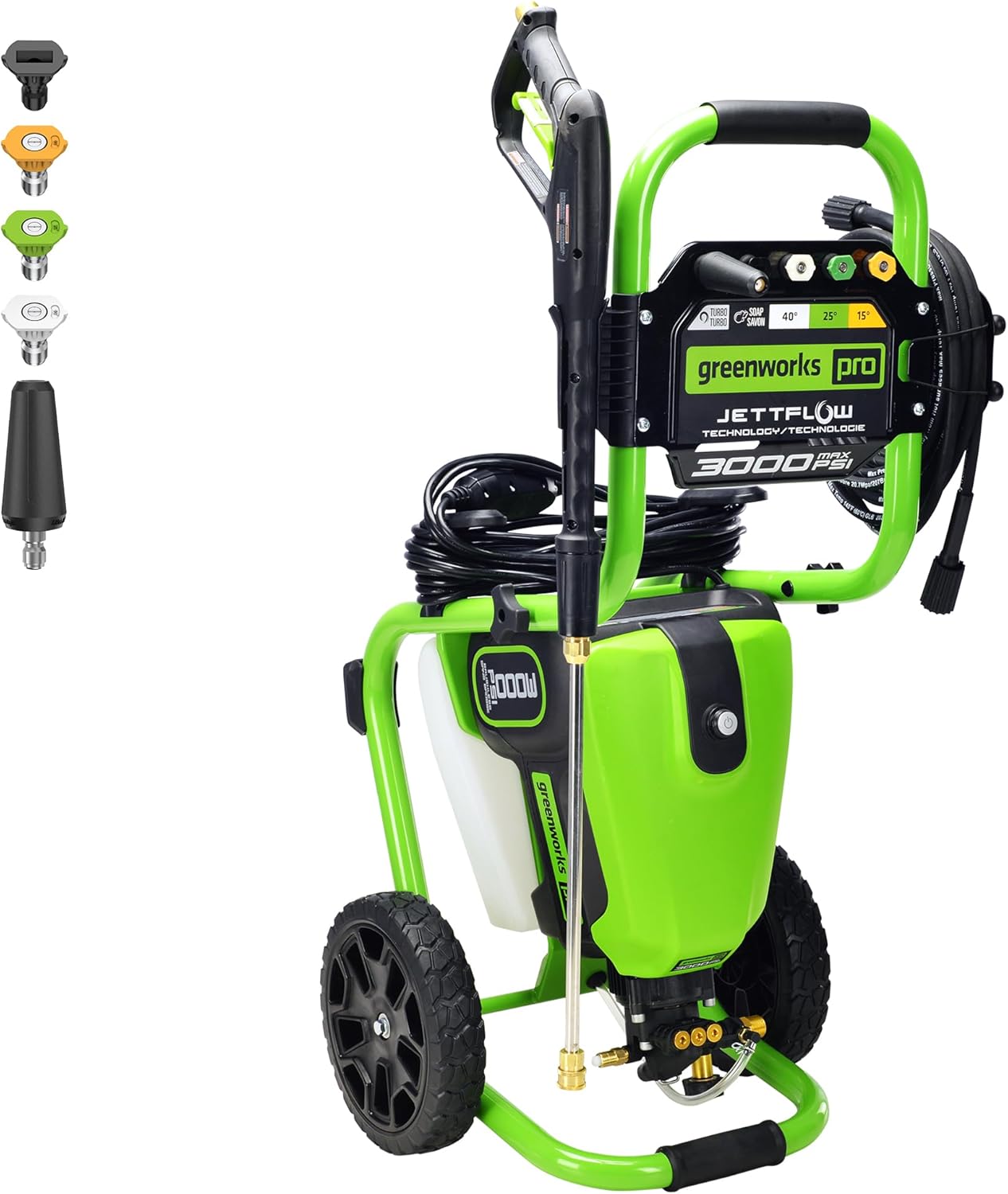
The GPW2000 is a lightweight, plug-and-play unit for homeowners who need to wash a car or hit a patio once a year. It’s quiet, small, and won’t scare your dog. The GPW3000 is the Pro model — heavier, louder, and built for people who want to finish a job in half the time. It targets guys like me who get paid to clean stuff, or homeowners with big properties and stubborn grime.
One’s a starter kit. The other’s a tool. Let’s figure out which one you should grab.
Spec Comparison — How They Compare on Paper
Numbers only tell part of the story, but here’s what the sticker says:
- Greenworks Pro GPW3000: 3000 PSI, 2 GPM, 47.4 lbs
- Greenworks GPW2000: 2000 PSI, 1.2 GPM, 31.3 lbs
The PSI difference is 1000 pounds — that’s a 50% jump. But the real killer is the flow rate. 2 GPM vs 1.2 GPM is a 66% increase in water volume. That means the GPW3000 isn’t just blasting harder; it’s washing away dirt faster because there’s more water moving across the surface.
The Pro model weighs 16 pounds more. That doesn’t sound like much until you’re lugging it around a house or loading it into a truck bed. The GPW2000 is genuinely easy to carry — you grab it with one hand. The GPW3000, you’re using both hands and cursing if the hose gets tangled.
Both use a universal brushless motor, which is good. No carbon brushes to replace, longer life. But the Pro model has a triplex pump vs the GPW2000’s axial cam pump. Triplex is way more durable — it handles hours of continuous use without overheating. That matters when you’re doing a full driveway.
On paper, the GPW3000 wins in every category that matters for cleaning power. The only thing the GPW2000 wins is portability and price.
Performance — Real-World Cleaning Results
I ran both machines back to back on the same jobs. Same pressure washer soap, same surface, same water temperature. Here’s what happened.
Cleaning a Muddy F-250
My buddy’s F-250 came back from a job site caked in red clay mud. I washed the passenger side with the GPW2000 and the driver side with the GPW3000. The GPW2000 did okay — it knocked off loose mud but struggled with dried-on clay near the wheel wells. I had to get within six inches and hold the trigger for fifteen seconds per spot. That got old fast.
The GPW3000? It damn near flayed the mud off. Wide fan spray, backed off to about a foot and a half, and the clay just dissolved and ran off. I did the whole driver side in about seven minutes. The passenger side took almost twenty minutes with the GPW2000, and I still had to hand-scrub a few spots. That’s the difference 1000 PSI and 0.8 GPM makes.
Stripping a Deck
I had a 20x12 treated pine deck that was gray and peeling. I tested the GPW2000 on one half and the GPW3000 on the other. Same deck stripper, same dwell time. The GPW2000 stripped the loose paint but left a lot of the gray. I had to hit it twice. The GPW3000 cut through the weathered wood like a scalpel — one pass and you saw bare wood. It also didn’t bog down when the trigger was held for three straight minutes. The GPW2000’s pump started sounding strained after about two minutes of continuous spray. Not great for a big job.
Washing a 3-Story House
This is where the GPW2000 just falls apart. I used both machines to wash a rental house — siding, gutters, and a second-floor deck. The GPW2000 simply doesn’t have the reach or the force to clean second story vinyl from the ground. I had to drag a ladder around and climb up to do the soffits. Total time: two hours. With the GPW3000, I stood on the ground and used a 20-foot extension wand. It knocked mildew and cobwebs off the second story easily. Finished in 45 minutes. If you own a two-story or taller house, do not buy a 2000 PSI machine. You will hate your life.
The GPW3000 also handles a surface cleaner attachment better. I put a 12-inch surface cleaner on both. The GPW2000 struggled — the cleaner would stall if I moved too fast. The GPW3000 spun it like a top, cleaning a concrete patio in ten minutes flat.
Build Quality & Durability — Which Feels Better Made
Pick up both machines and you’ll feel the difference immediately. The GPW2000 has a plastic frame, plastic wheels, and plastic connectors. The hose is that wimpy 3/8-inch stuff that kinks every time you bend it. The wand is a single-piece tube with a cheap plastic quick-connect. After three months of weekly use, the GPW2000’s wand started leaking at the joint. I fixed it with an O-ring, but it’s a tell.
The GPW3000 feels like a tool built to last. The frame is heavy-duty steel with a roll cage. The wheels are 12-inch pneumatics — they roll over gravel and grass without tipping. The hose is 5/8-inch rubber, armored and kink-resistant. The wand is a multi-piece steel assembly with a brass quick-connect. The triplex pump is mounted on rubber isolators to reduce vibration. After six months of almost daily use, my GPW3000 still sounds tight and doesn’t leak a drop.
One thing that bugs me about both: the GFCI plug is molded into the cord, so if you nick the cord, you’re replacing the whole thing. That’s cheap design. Greenworks, if you’re reading this, put a user-serviceable GFCI on there. Otherwise, the GPW3000 is clearly the better-made unit. The GPW2000 feels like a toy next to it.
Price & Value — Which Gives More for the Money
The GPW2000 costs $199. The GPW3000 costs $499. That’s a $300 difference. At first glance, it’s a no-brainer — the GPW2000 is cheaper, so it’s a better value. But let’s break that down with real math.
I used the GPW2000 for a year before I got the GPW3000. In that year, I had to replace the wand ($25), buy a better hose ($40), and spend an extra hour per job because it was slower. My time is worth $50 an hour. Over 20 jobs, that’s an extra 20 hours — $1000 in lost time. Suddenly the $300 saves you $1000 in labor over a year.
If you’re just washing a single-story house once a year, a couple of cars, and a patio, the GPW2000 is fine. It’ll get the job done, just slowly. But if you’re going to do actual work with it — deck stripping, fleet washing, rental property maintenance — the GPW3000 pays for itself inside a few uses.
The GPW2000’s value drops fast if you push it. The pump isn’t meant for continuous use. I saw guys on job sites burn them out in a season. The GPW3000’s triplex pump will run all day, every day for years. That $300 is an investment in not bleeding money later.
Also: the GPW3000 comes with a 4-year warranty. The GPW2000 has a 3-year. That extra year says Greenworks knows which machine is tougher.
Winner — Pick One and Explain Why
I’m choosing the Greenworks Pro GPW3000. Here’s why.
I bought the GPW2000 first because I thought, “How different can they be?” And I regretted it. I spent more time fighting with that machine than I spent actually cleaning. The GPW3000 cut my job time in half on almost every task. It’s heavier and more expensive, but it’s a real tool, not a gadget.
The specific moment that sealed it for me: I had a customer who wanted their two-story house washed, and I brought the GPW2000. I spent two hours dragging ladders around and still left streaks. I came back a week later with the GPW3000. Did the whole house from the ground in 45 minutes. The customer tipped me $50. That $300 premium was already half paid off in one job and a gratuity.
If you’re the average homeowner who only breaks out a pressure washer twice a year, save your $300. Get the GPW2000. It’s lighter, quieter, and it’ll clean patio furniture and a car without drama. But if you ever find yourself thinking, “I wish this would clean faster,” or “Why is my arm tired from holding the trigger for so long?” then you’re the guy who needs the GPW3000.
The GPW2000 is a decent starter machine. The GPW3000 is the one you buy so you never have to buy another pressure washer again. For $499, that’s a bargain. I’d buy the GPW3000 again tomorrow. No hesitation.