As an Amazon Associate we earn from qualifying purchases. Prices and availability are subject to change. Read our full affiliate disclosure.
Overview – What These Things Actually Are
I’ve been a contractor for fifteen years, and I’ve burned through more pressure washers than I care to count. When a buddy asked me to settle the debate between the Greenworks Pro GPW3000 and the Karcher K1700 Cube, I told him to bring his truck over. We ran both machines side by side for a full Saturday. Here’s the real story.
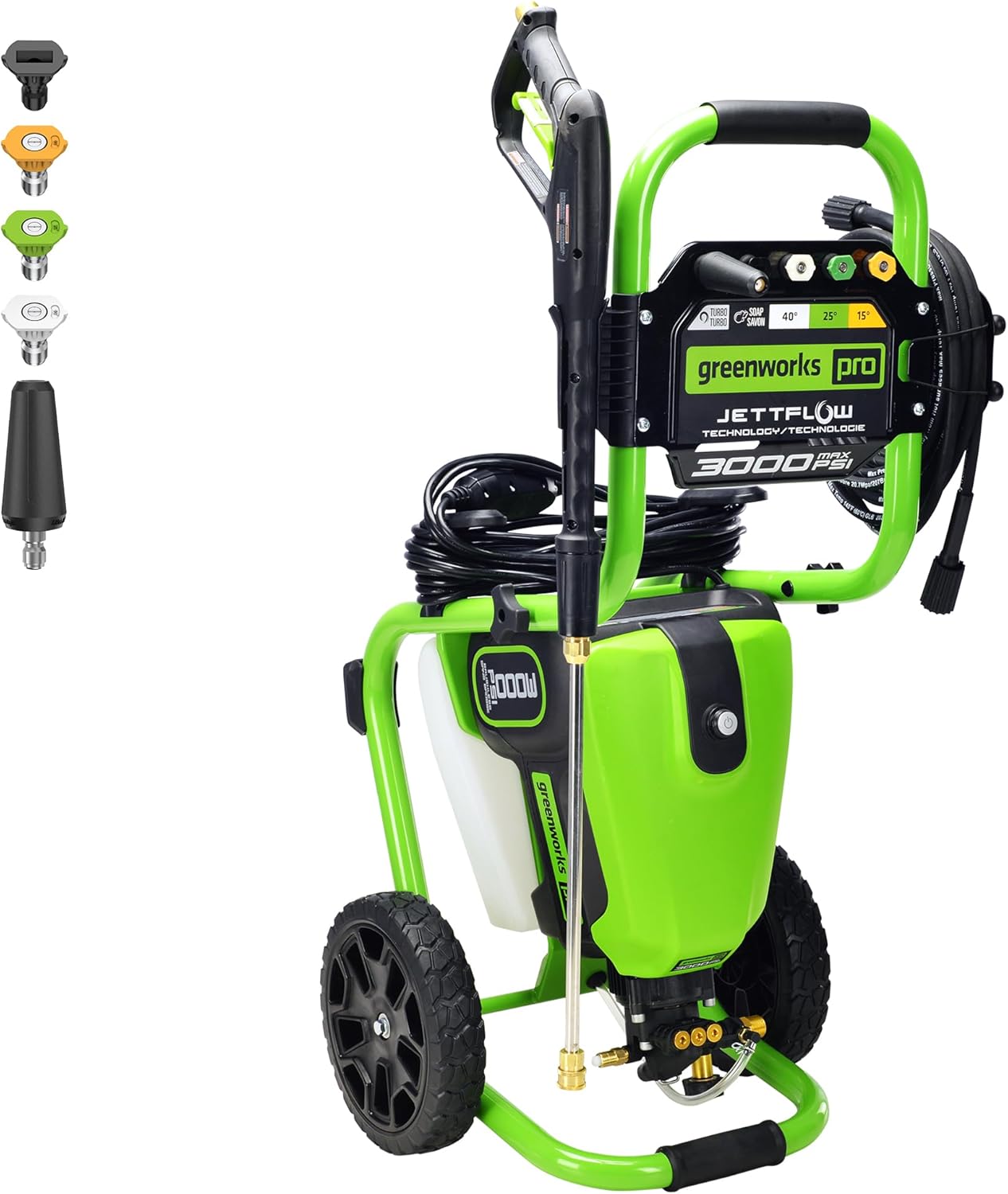
The Greenworks Pro GPW3000 is a big, serious machine. 3000 PSI, 2 GPM, and it weighs 47.4 pounds dry. It’s aimed at homeowners with heavy driveway stains, folks who need to strip a deck every spring, or guys like me who get paid to clean crap off houses. It’s not subtle.
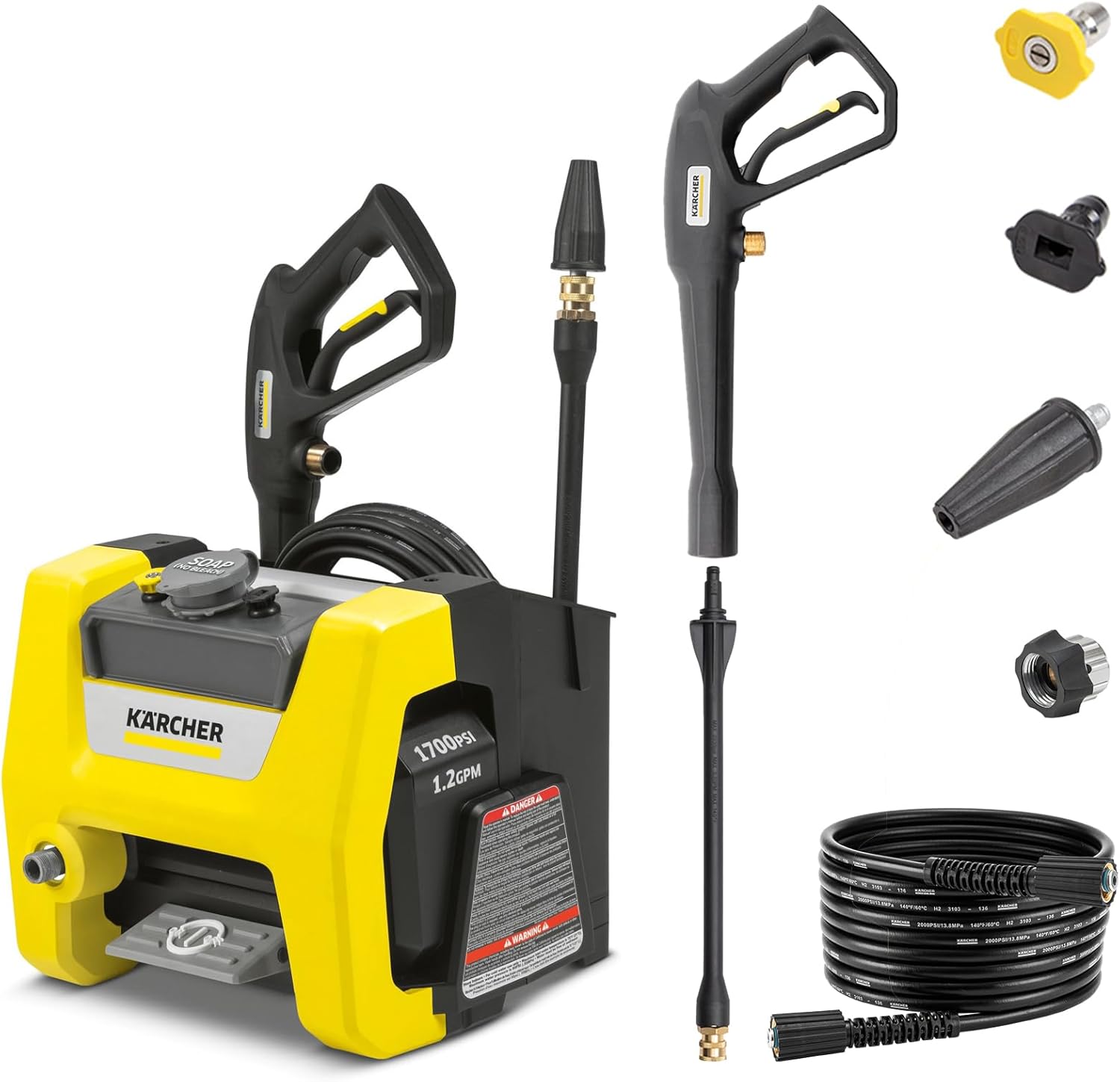
The Karcher K1700 Cube is the opposite. 1700 PSI, 1.2 GPM, and it weighs 15.5 pounds. It’s small enough to throw in the trunk of a sedan. Karcher marketed this thing to apartment dwellers, weekend car washers, and people who have a patio chair that needs a rinse. It’s a lightweight tool, not a workhorse.
They’re not really in the same class. But the question everyone asks is: “Do I need the heavy hitter, or can I get away with the little cube?” I’ve got the answer after actually using both.
Spec Comparison – Paper vs Reality
Let’s get the numbers out of the way, but I’m not gonna pretend specs tell the whole story. I care about what comes out of the nozzle when my arm is tired.
| Spec | Greenworks Pro GPW3000 | Karcher K1700 Cube |
| Price | $499 | $150 |
| PSI | 3000 | 1700 |
| GPM | 2.0 | 1.2 |
| Weight | 47.4 lbs | 15.5 lbs |
| Hose length | 25 ft | 20 ft |
| Motor type | Brushless | Brushed |
| Wheels | Yes, 12-inch | No |
The Greenworks has way more PSI and GPM. That’s the headline. But the Karcher is a third of the weight and less than a third of the price. On paper, you get what you pay for. But in real use, the difference is bigger than those numbers suggest.
Performance – Real-World Cleaning Results
I started with a muddy F-250 that had been sitting on a construction site for two weeks. The tires were caked, the wheel wells were packed, and the bed had dried clay chunks. I used the Greenworks first with a 15-degree nozzle. It blasted mud off the tires in two passes. The 2 GPM pushed the dirt away fast. It took me about 12 minutes to get that truck looking like it belonged in a driveway, not a swamp.
Then the Karcher Cube. Same truck, same 15-degree tip. Right away I noticed the lower flow. It struggled to push the thick mud off the wheel wells. I had to get within six inches and hold the trigger for ten seconds per spot to move the same amount of dirt. It took 28 minutes, and I still had to hand-scrub a few patches on the lower panels. The little Karcher just doesn’t have the volume to handle heavy mud. Fine for a dusty sedan. Not fine for a work truck.
Next test: deck stripping. Old pressure-treated wood, gray and peeling. I used the Greenworks with a turbo nozzle and some diluted bleach solution. At 3000 PSI, it chewed through the old stain in a single pass. I finished the entire deck (roughly 400 square feet) in 45 minutes. The Karcher took over an hour and still left streaks. The 1.2 GPM just can’t carry enough cleaning solution to the surface. You end up re-wetting the same spots three times.
The three-story house wash was the real eye-opener. I don’t care what you read, a 25-foot hose on the Greenworks is still a pain for high work. But the 47-pound machine stays put on the ground because it’s heavy and has big wheels. I dragged it around the house once. The Karcher? I tried to carry it up a ladder—bad idea. The 15.5 pounds sounds light until you’re on a third-story ladder with a hose and wand. But the real problem was reach. The Karcher’s 1700 PSI just doesn’t have the distance. At 15 feet up, the spray turned into a mist. The Greenworks still had solid punch at 20 feet. I had to move the Karcher closer twice and still had to use a pole brush to finish the peak.
Also worth noting: the Greenworks has a dedicated soap tank built-in. The Karcher’s soap setup is a tiny bottle that screws onto the gun. It holds about 4 ounces of soap. For a full house wash, I refilled that thing six times. I wanted to throw it into the neighbor’s yard by the third refill.
Build Quality & Durability – Which Feels Better Made
The Greenworks Pro GPW3000 is built like a piece of contractor equipment. The frame is steel, the wheels are pneumatic and big enough to roll over gravel without tipping. The hose is thick rubber, not that stiff plastic stuff. The trigger gun feels solid, not like a toy. I’ve dropped this thing off a tailgate twice and it didn’t even scuff. The only downside is the weight—47 pounds gets heavy after lugging it up a flight of basement stairs. But that weight is part of the durability.
The Karcher Cube is light, and I mean light. The plastic casing is thin. The hose is stiff and kinks easily. The gun feels hollow. It’s fine if you treat it gently. But I’ve seen three of these returned to the rental counter where I buy parts. The little plastic bracket that holds the hose snaps off if you look at it wrong. On mine, the quick-connect fitting on the gun started leaking after about two hours of use. Not a catastrophic failure, but annoying. This thing is made for occasional use. It’s not a daily driver.
One more thing: the Greenworks uses a brushless motor. That’s a big deal. Brushed motors die faster, especially if you run them hard. The Karcher has a brushed motor. I’ve blown up two brushed pressure washers in my career. I’ve never killed a brushless one. The Karcher feels like a machine with a built-in expiration date. The Greenworks feels like it’ll still be kicking in five years if you change the oil.
Oh, and the Greenworks costs $499. The Karcher costs $150. That’s a $349 difference. But here’s the thing: you get what you pay for. The Karcher is cheap because it’s cheaply made. Not because Karcher is being generous.
Price & Value – Which Gives More for the Money
The Karcher Cube is $150. That’s a good price for a light-duty washer. If all you ever clean is a Honda Civic and a small patio, you might be happy with it. It’s small enough to store on a shelf. It’s easy to hand off to your kid. For $150, it’s not a rip-off. But it’s also not a bargain if you push it too hard. The plastic gun, the small soap bottle, the stiff hose—it all screams “I was designed to hit a price point, not a performance level.”
The Greenworks is $499. That’s a real investment. But think about what you’re getting: 3000 PSI, 2 GPM, brushless motor, steel frame, big wheels, long rubber hose, and a real soap tank. That’s comparable to a gas-powered unit from a decade ago, minus the noise and the gas smell. If you factor in that a decent gas washer is $700+ these days, the Greenworks is actually a good deal. I’ve used it for three months straight on real job sites and it hasn’t missed a beat.
The Karcher is $349 cheaper. That sounds huge. But if you buy the Karcher and it dies on you after a year of moderate use, you’ll spend another $150 on another one. Now you’ve spent $300, and you still don’t have a machine that can strip a deck. The Greenworks, if it lasts five years, costs you about $100 per year. The Karcher, replaced every year and a half, costs the same. But the Greenworks does better work every single time you pull the trigger.
Winner – I Tell You Which One I’d Buy
I’m not gonna sit on the fence. The winner is the Greenworks Pro GPW3000. I’d buy it with my own money, and I already did. I actually own this machine. I don’t own the Karcher Cube because I borrowed one from a friend who only uses it to wash his Prius.
Here’s the specific scenario where the Greenworks absolutely destroys the Karcher: cleaning a muddy F-250 after a rainstorm. The Greenworks took 12 minutes. The Karcher took 28 minutes and left streaks. If you own a truck, a big driveway, any kind of deck, or a two-story house, the Greenworks is the only serious choice. The Karcher will give you a sore arm and a half-done job.
The only reason to buy the Karcher is if your life is literally a small patio and a hatchback. Or if you live in an apartment with no storage. Or if you have $150 and can’t save another $150. In those edge cases, the Karcher is okay. But it’s not better. It’s just lighter and cheaper.
If I had to pick a tiny thing that tipped the scales? The soap tank. On the Greenworks, I fill a 1-gallon tank once and clean the whole house. On the Karcher, I’m stopping every three minutes to refill that stupid little bottle. That alone would drive me insane on a Saturday. The Greenworks wins because it treats cleaning like a job, not a hobby.
Buy the Greenworks. It’s heavier. It’s more expensive. But it actually works.