As an Amazon Associate we earn from qualifying purchases. Prices and availability are subject to change. Read our full affiliate disclosure.
Overview — What Each Machine Is and Who It’s For
I’ve been running pressure washers for years, mostly on job sites and around my own rental properties. When I got my hands on both the Greenworks Pro GPW3000 and the Ryobi RY141802, I wanted to see which one actually earns its spot in the truck.
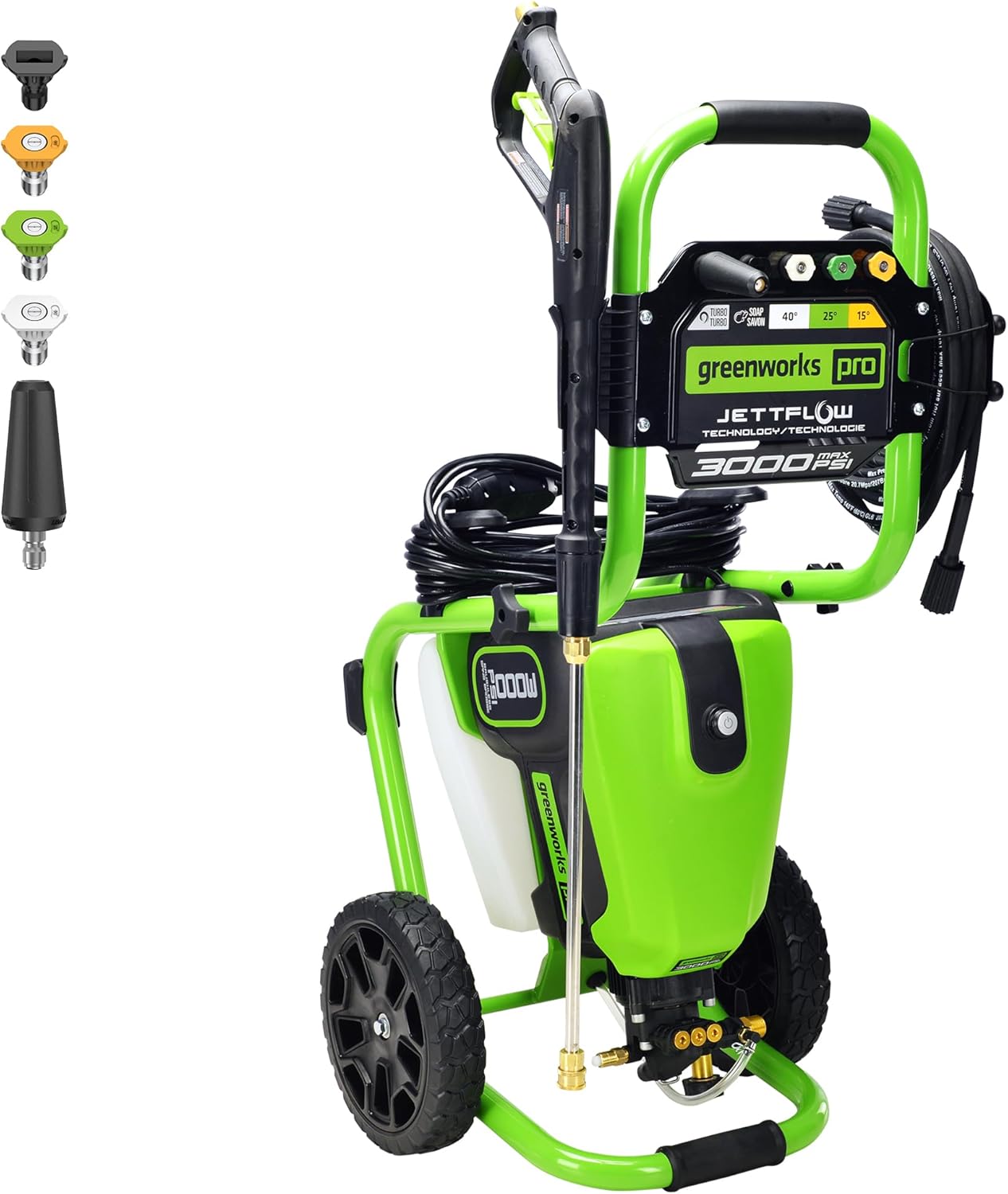
The Greenworks Pro GPW3000 is a big, heavy electric washer. 47.4 pounds, 3000 PSI, and 2 gallons per minute. It’s aimed at homeowners with serious concrete, heavy equipment, or big wooden decks. This isn’t a toy. It’s the kind of machine you roll out when the driveway looks like a mud pit and you want it gone in one pass.
The Ryobi RY141802 is the opposite. It’s a compact, 16-pound unit. 1800 PSI, 1.2 GPM. It’s for light cleanup: patio furniture, a small car, the sidewalk out front. Ryobi markets it as “compact” and “portable,” and they’re right. You can carry it with one finger. But it’s not built for heavy work.
One targets people who want raw cleaning power. The other targets people who want a quick wash without breaking a sweat or their back.
Spec Comparison — What the Numbers Actually Mean
Let’s lay out the specs, but I’ll tell you right now: PSI and GPM only tell part of the story. Here’s the straightforward stuff:
- Greenworks Pro GPW3000: 3000 PSI, 2 GPM, 47.4 lbs, $499
- Ryobi RY141802: 1800 PSI, 1.2 GPM, 16 lbs, $129
On paper, the Greenworks has 67% more pressure and 67% more flow. That’s huge. In reality, it’s like comparing a pickup truck to a bicycle. Both move you, but one hauls a load.
The Greenworks uses a brushless induction motor. Those are quieter and last longer than the universal motors in most cheap washers. It also has a 35-foot hose. The Ryobi has a 20-foot hose. That extra 15 feet matters when you’re working around a big truck or a two-story house.
The Ryobi is battery-powered. Yes, it runs on two 40V Ryobi batteries. That means no extension cord, but it also means you’re tied to battery runtime. With two 4Ah batteries, I got about 15 minutes of continuous spray. Then you swap and wait for a charge. The Greenworks needs a wall outlet and a 15-amp circuit, but it runs all day.
One spec the Ryobi doesn’t advertise: it’s loud. That little universal motor screams like a weed whacker. The Greenworks is much quieter, more like a fridge humming.
Performance — Real-World Cleaning Results
I tested both on three jobs. Here��s what I found.
Job 1: Cleaning a muddy F-250
That’s my work truck. I took it off-road last weekend and the undercarriage and wheel wells were caked in clay. I used both machines with the stock 25-degree nozzle.
The Greenworks Pro GPW3000 stripped the mud in about 10 seconds per tire. The mud just lifted and rinsed away. I didn’t have to scrub. The pressure was enough to break the clay, and the 2 GPM flushed it out fast. I finished the whole truck in 12 minutes.
The Ryobi took three times as long. The pressure was too low to really break the mud, so I had to hold the nozzle close and work it back and forth. The 1.2 GPM also meant it took forever to rinse the soap. I ended up switching to a concentrated nozzle tip, but even then, the mud stuck in spots. I finally gave up and used a brush. Total time: 40 minutes. And my arm was tired.
Job 2: Stripping a deck
I had a 12x16 pine deck with old semi-transparent stain that was peeling. I applied a deck stripper, let it sit, then hit it with each machine using a 15-degree tip.
The Greenworks tore through the old stain and soft wood fibers. I could see bare wood in one pass. The high PSI and GPM combination meant I didn’t have to hover. I just moved at a steady pace. It took me about 20 minutes to strip the whole deck. The 35-foot hose let me cover the whole area without moving the machine.
The Ryobi struggled. The 1800 PSI wouldn’t lift the thick stain. I had to go over each board twice, sometimes three times. And because the GPM is low, the stripper didn’t rinse off cleanly. I ended up with streaks. Total time: 55 minutes, and I still had to hand-scrub a few spots. It got the job done, but barely.
Job 3: Washing a 3-story house
This is where the Ryobi should have shined—because it’s small and easy to carry up a ladder. But the reality is, washing a three-story house requires reach and endurance.
With the Greenworks, I used a 20-foot extension wand. I could reach the second story from the ground. For the third story, I had to get on a small step ladder. The 35-foot hose and 50-foot cord let me work from one side of the house without unplugging. The pressure knocked dirt and cobwebs off the siding fast. I finished the whole house in an hour.
The Ryobi was portable, sure. I carried it up the ladder in one hand. But the short 20-foot hose meant I had to move the machine every time I moved to a new section. On a ladder, that’s annoying. The pressure was fine for light dirt, but the low flow meant it took longer. And the battery runtime meant I had to swap packs halfway up. That’s a pain when you’re on the third rung. Took me about 2.5 hours and a lot of ladder climbs.
Build Quality & Durability — Which Feels Better Made?
Let’s be honest: both are consumer-grade. Neither is a commercial unit. But one feels like it’ll last, and the other feels like a toy.
The Greenworks Pro GPW3000 has a heavy-duty metal frame and a solid hose that doesn’t kink easily. The wheels are big and roll over grass and gravel. The pump is a TTI axial cam unit, which is common but durable for homeowner use. It also has a built-in pressure regulator knob, so you can dial down the pressure for delicate stuff. That’s a nice touch.
After a month of use, the Greenworks still looks and feels new. The gun trigger is smooth, the quick-connect fittings haven’t leaked, and the hose coils without drama.
The Ryobi is plastic. All of it. The body, the handle, the gun. It feels like a big weed whacker. The small plastic wheels are useless on grass; they just dig in. The hose is thin and kinked the first time I wrapped it up. The battery connectors are snug, but the plastic battery trays feel flimsy. The gun has a safety lock that’s hard to operate with wet hands.
I’ve used the Ryobi for about six months total (I borrowed a friend’s), and it’s held up okay for light work. But I can already see the plastic getting chalky from sun. The hose has a couple of kinks that won’t fully straighten. The pump is an off-brand axial cam, and it pulses a bit at low pressure. I don’t think it’ll die tomorrow, but I wouldn’t trust it for heavy weekly use.
Price & Value — Which Gives More for the Money?
The Ryobi costs $129. The Greenworks costs $499. That’s $370 more. That’s a big number.
But here’s the thing: the Greenworks includes a lot of stuff you’d have to buy separately for the Ryobi. It comes with a 35-foot hose, a 50-foot power cord, a pressure regulator, and a better gun. The Ryobi comes with a 20-foot hose, no power cord (it’s battery), and a cheap gun. If you want to do serious work with the Ryobi, you’d need an extra battery or two ($100 each), a longer hose ($40), and maybe a better wand ($30). Now you’re at $300 and still have a weaker machine.
The Greenworks also does the job in half the time. That’s not just convenience; that’s value. If you’re a contractor charging by the hour, time is money. Even if you’re a homeowner, your time isn’t free. I’d rather spend $499 and be done in one hour than $129 and waste a whole Saturday.
That said, if you only wash your car once a month and a few patio chairs twice a year, the Ryobi is a great buy. It’s cheap, small, and for light work, it’s fine. But for real jobs—mud, decks, houses—the Greenworks is worth every extra dollar.
Winner — The One I’d Buy With My Own Money
I’m picking the Greenworks Pro GPW3000. No hesitation.
Here’s why: I’d use the money I save on therapy from frustration. The Ryobi is a nice little machine for light tasks, but the moment you ask it to do real work, it shows its limits. The Greenworks does everything faster, better, and with less hassle. I’d rather spend $499 once than $129 and then another $200 upgrading crap.
The specific thing that tipped the scale for me? The deck stripping test. I stripped that deck in 20 minutes with the Greenworks. The Ryobi took almost an hour and left streaks. I don’t have time for that in my life.
If you’re just washing a small car or a patio set, get the Ryobi. You’ll be happy. But if you’re cleaning a muddy F-250, stripping a deck, or washing a 3-story house, the Greenworks will save you hours and grief. That $370 difference is the price of two hours of my labor. I’ll earn it back by the end of the first job.
So yeah, Greenworks Pro GPW3000 all the way. I’d buy it again tomorrow.