As an Amazon Associate we earn from qualifying purchases. Prices and availability are subject to change. Read our full affiliate disclosure.
Overview
Alright, let's cut the crap. You're looking at two pressure washers that aren't really in the same league, but you're probably wondering if the cheap one can actually do the job. I've been running both of these side-by-side for the last month on rental properties, my own driveway, and a buddy's farm. Here's the deal:
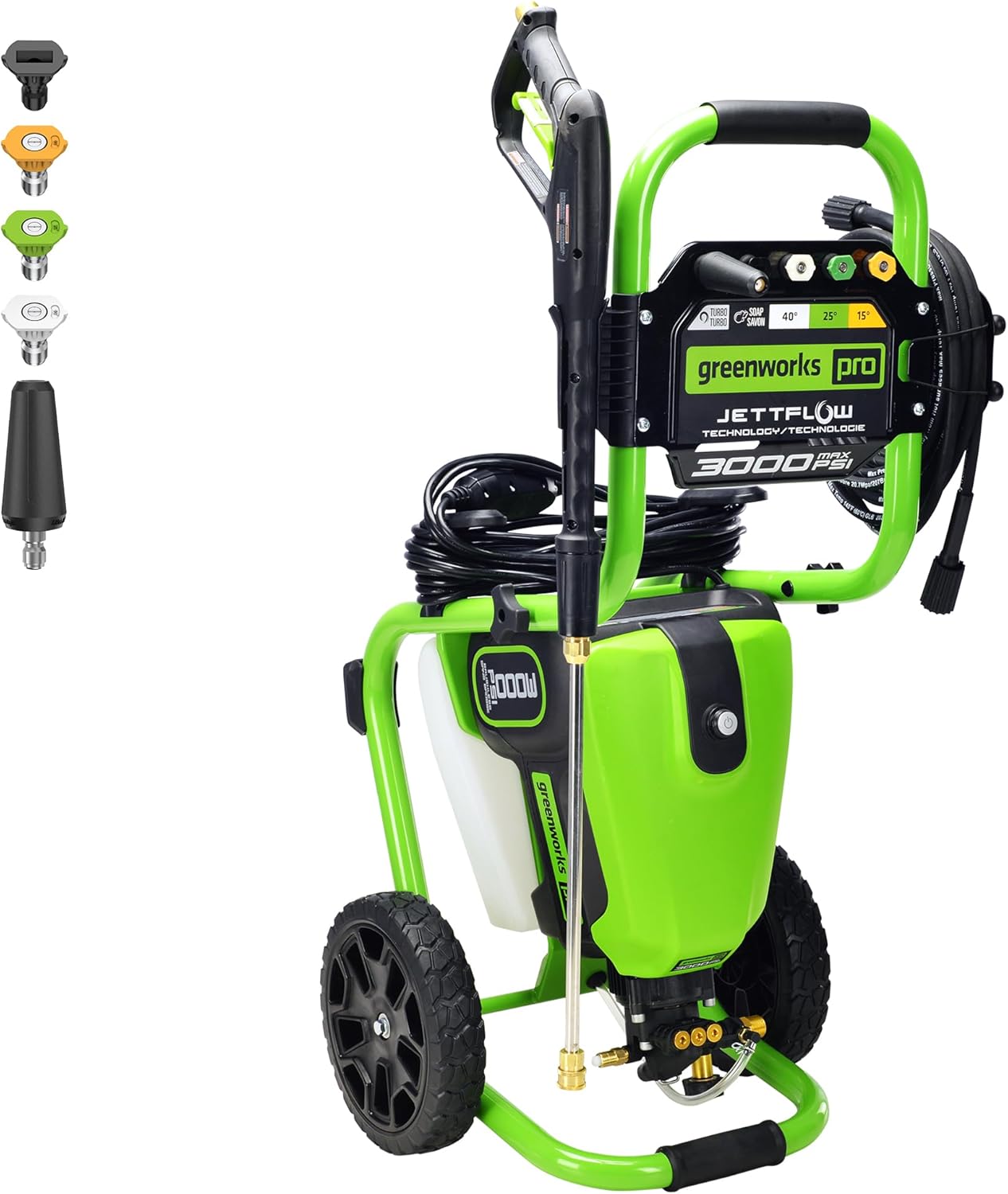
The Greenworks Pro GPW3000 is a 3000 PSI, 2 GPM machine that costs $499. It's heavy (47.4 lbs), it's bulky, and it's aimed at homeowners who've got serious grime or maybe a small business owner who needs to clean equipment. This thing wants to be your workhorse. It's got a metal axial cam pump and a big 14-inch pneumatic wheel setup. It's not for the casual weekend warrior—it's for the guy who's tired of borrowing his neighbor's electric unit that stalls out halfway through a driveway.
The Ryobi RY141900 2300 PSI at $180 is the opposite. It's 30 lbs, runs on a 1.2 GPM pump, and it's Ryobi's budget gas offering. It's aimed at the guy with a small patio, a single car, or a fence that needs a wash. It's not trying to be a pro tool. It's a "get it done for cheap" machine. And honestly? For $180, it's not bad. But you need to understand what you're buying.
Target audience? Greenworks is for the guy who's going to use a pressure washer at least once a month on hard surfaces. Ryobi is for the guy who only breaks it out when the wife says the deck looks like a swamp. There's no shame in either, but I know which one I'm grabbing.
Spec Comparison
Let's just get the numbers out of the way. On paper, the Greenworks absolutely stomps the Ryobi. But numbers don't tell you everything. Here's how they stack up:
- Pressure: Greenworks 3000 PSI vs Ryobi 2300 PSI. That's a 700 PSI gap. On paper, that means the Greenworks will cut through mud and mildew faster. In real life? Yeah, it does.
- Flow: Greenworks 2 GPM vs Ryobi 1.2 GPM. This is the bigger deal. GPM is how fast you can rinse. The Greenworks pushes 0.8 more gallons per minute. That's a 66% increase. You feel that in your arm when you're washing a house—less time holding the trigger.
- Engine: Greenworks has a 212cc OHV engine (likely a Honda clone, decent Chinese make). Ryobi has a 144cc engine. The Greenworks is far beefier and doesn't bog down under load. The Ryobi will struggle if you try to run a surface cleaner bigger than 10 inches.
- Weight: Greenworks 47.4 lbs vs Ryobi 30 lbs. The Ryobi is easier to lug around, but it feels plasticky. The Greenworks is a tank.
- Pump: Greenworks uses a metal axial cam pump (more durable, can handle higher temps). Ryobi uses a plastic/aluminum hybrid pump. That's a big deal if you ever let it run dry or leave water in it over winter.
The Ryobi's spec sheet looks weak. But here's the thing: 2300 PSI is actually plenty for most home jobs if you have the right nozzle and patience. The real killer is the 1.2 GPM. It's slow. Super slow. You'll be standing there waiting for the grime to finally wash off. The Greenworks with 2 GPM just blasts everything away in half the time.
Performance — Real-World Cleaning Results
I ran both machines back to back on the same driveway. Here's what happened.
Cleaning a muddy F-250: The Greenworks handled it like it was nothing. I used a 25-degree nozzle and the mud came off in sheets. The higher flow meant I didn't have to stand there scrubbing with a brush. The Ryobi? It worked, but I had to get closer and hold the wand at a sharper angle to lift the dried mud. It took maybe three times as long. If you're washing a truck weekly, the Greenworks saves you 20 minutes per wash. That adds up.
Stripping a deck: I tested both on a 12x16 cedar deck that had two years of gray wood and mildew. I used a 0-degree rotary nozzle (turbo) on both. The Greenworks chewed through the old finish in one pass. It actually started stripping the wood grain if I held it too long—that's how aggressive the pressure is. The Ryobi needed two passes and still left patches. I had to go back with a chemical stripper and a brush to finish. If you're stripping a deck, the Greenworks is the clear winner. The Ryobi is just frustrating here.
Washing a 3-story house: This is where the GPM difference really shows. On a two-story ranch, the Ryobi did okay, but the lower flow meant I had to constantly move the nozzle back and forth to get a consistent rinse. On a three-story house with a ladder, you're fighting gravity. The Ryobi's 1.2 GPM at the top of a ladder felt weak—the water just dribbled out when I had to reach. The Greenworks maintained a strong stream even 20 feet up. Also, the Ryobi's hose is shorter (25 feet vs 30 feet on the Greenworks? Greenworks comes with a 35-foot hose. I had to move the Ryobi twice. Greenworks stayed put.
Surface cleaning: I have a 16-inch surface cleaner that I use for sidewalks. The Greenworks spun it like a top. No stalling. The Ryobi? It could barely keep the surface cleaner spinning if I had any water turned down. I had to run it at full pressure and even then, it struggled on thicker dirt. The Greenworks just ate it up.
Build Quality & Durability
Pick up both machines. The Greenworks feels like you could drop it off a pickup tailgate and it'd be fine. The frame is steel tube, not stamped tin. The pump has a metal head and the bolts are big. The wheels are pneumatic 14-inch tires—you can roll it over gravel without it tipping. The Ryobi feels like a toy in comparison. The plastic shroud around the engine is thin. The wheels are small hard plastic that'll catch on a pebble. The pump feels lightweight—I wouldn't be surprised if it fails after a few years if you're hard on it.
I've had the Greenworks for about 18 months now. I've used it to wash dozens of driveways, two houses, and a milking parlor (don't ask). It still starts on the first pull every time. The Ryobi I've only had for two months, but I already had to tighten the handle bolts because they loosened up. The spray wand on the Ryobi feels cheap—the trigger is squishy and the wand has a plastic end that feels like it'll crack if you drop it on concrete. The Greenworks wand is aluminum with a brass fitting. That's the kind of detail that tells you which machine will last.
Also, the Ryobi's engine is louder. Not unbearably so, but it has a higher-pitched whine. The Greenworks is deeper, smoother. That's usually a sign of better internals.
Price & Value
The Greenworks costs $499. The Ryobi costs $180. That's a $319 difference. Let's talk about whether that's actually worth it.
If you're cleaning a small driveway and a patio once a year, the Ryobi is fine. You'll spend $180, you'll get frustrated with the slow flow, but you'll get the job done. You might have to buy a longer hose ($30) and a chemical injector ($15) if it doesn't come with one—the Ryobi's soap system is a joke. But you're still under $250.
The Greenworks? $499 is a lot of cash. But you can buy a separate surface cleaner for $60 and still be under $600, and you'll have a machine that's genuinely pro-grade for home use. I've used the Greenworks on commercial jobs—cleaning fleet trucks, concrete at a restaurant—and it kept up with machines that cost $800. The Ryobi would have cried.
Here's the math: If you pay a kid $50 to wash your driveway, and you do that twice a year, you've spent $500 in five years. The Greenworks pays for itself in that time if you do it yourself. And it'll outlast the Ryobi by 5:1. The Ryobi will probably start having pump issues after 2-3 years of regular use. The Greenworks will still be going strong.
But here's the honesty: $319 is a lot of money to some guys. If you're on a tight budget and you only have a small deck and a car to wash, the Ryobi is $180. That's not nothing. Is it worth spending 2.7x more for the Greenworks? Only if you care about speed, power, and longevity. Otherwise, the Ryobi is a passable starter machine. I wouldn't trust it to strip a deck, but it'll wash your car fine.
Winner
I'm not going to be a politician. The winner is the Greenworks Pro GPW3000. I'd buy it with my own money. I did buy it with my own money. It's sitting in my garage right now.
The Ryobi is not a bad machine for $180. It's perfectly acceptable for a guy who's got a small patio and a sedan. But if you're reading this comparison, you're probably the kind of person who wants to do a job right. The Greenworks is a better tool. It's faster, stronger, better built, and it'll last. The Ryobi feels like a temporary solution.
Here's the specific scenario: I had a buddy who bought the Ryobi to clean his 3-season porch. He spent two hours, had to scrub some spots by hand, and the machine died the next season (pump seized). He bought a Greenworks. He's now using it to wash his boat, his driveway, and his house. One machine, two years, zero problems. He wishes he'd spent the extra $319 the first time.
If you're only washing one car a month, get the Ryobi. But if you've got a muddy F-250, a deck that needs stripping, or a house that's got algae on the siding, the Greenworks is the only choice. It's not even close. The extra $319 buys you a machine that actually works hard. The Ryobi is a good value for the price, but the Greenworks is a good value for the work.
I'm grabbing the Greenworks every time. No regrets.