As an Amazon Associate we earn from qualifying purchases. Prices and availability are subject to change. Read our full affiliate disclosure.
Overview — What These Machines Are Built For
I’ve been running a handyman business for the better part of a decade, and I’ve probably burned through six pressure washers in that time. Some I killed, some just gave up. When the guys at the tool rental place started telling me to look at the Greenworks Pro GPW3000 and the Ryobi RY142300, I figured I’d buy both, run them side by side for a month, and see which one I’d actually keep. Here’s the real talk.
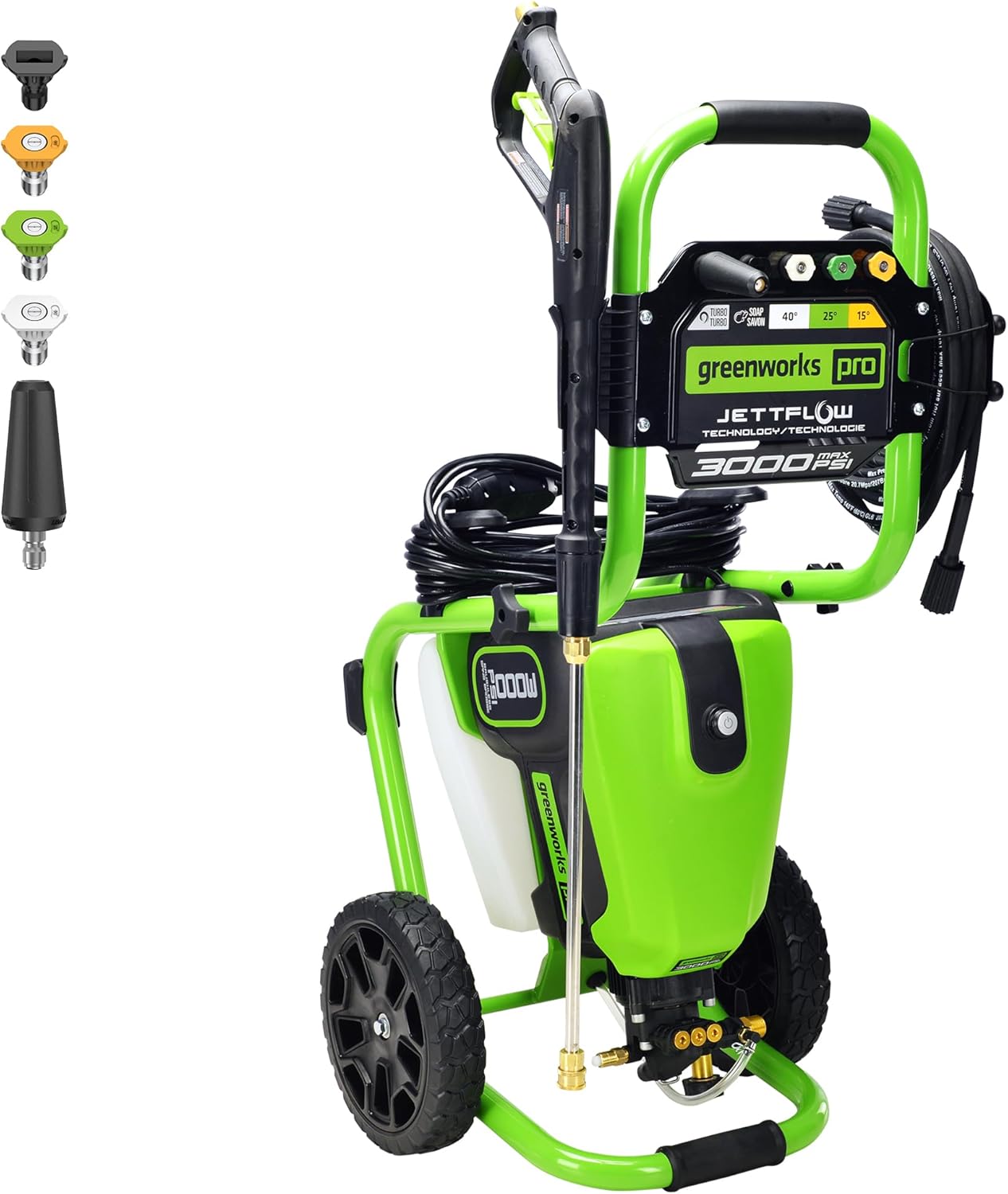
The Greenworks Pro GPW3000 is a 3000 PSI, 2 GPM machine that costs $499. It’s marketed as a prosumer unit—heavy enough to handle real work, but not stupid expensive. It’s got a brushless motor, a triplex pump, and it weighs 47.4 pounds. This thing is aimed at guys who own a house with a long driveway, a couple of decks, and maybe a muddy truck that sees dirt roads every weekend.
The Ryobi RY142300 is the budget option at $250. 2300 PSI, 1.2 GPM, and 49 pounds—somehow heavier than the Greenworks despite being less powerful. It’s also brushless, which is nice, but the pump is an axial cam unit. Ryobi markets this to the weekend warrior who wants to wash his car, clean the patio furniture, and maybe hit the sidewalk once a year.
Right off the bat, you can guess which one I’m leaning toward. But let’s not jump the gun.
Spec Comparison — Paper Don’t Mean Shit, But Look at This
Here’s the raw numbers, and I’ll tell you why they matter:
- Greenworks Pro GPW3000: 3000 PSI, 2 GPM. That’s 6000 cleaning units (PSI x GPM).
- Ryobi RY142300: 2300 PSI, 1.2 GPM. That’s 2760 cleaning units.
That’s a 117% difference in cleaning power. For $250 more, you’re getting more than double the flow. And flow is the real secret—PSI just blasts stuff, but GPM rinses it away. I’ve cleaned concrete with a 4000 PSI machine that only did 1.5 GPM, and it left grit everywhere. The Greenworks at 2 GPM just hoses the mud off in one pass.
The Ryobi is lighter on paper at 47.4 lbs vs 49 lbs, but that’s negligible. Both have 25-foot hose, both have a soap tank. But the Greenworks has a 14-inch surface cleaner included in the box. Ryobi doesn’t include one. That’s a $100 accessory right there.
The Ryobi is quieter. I’ll give it that. Brushless motors are generally quieter, but the Greenworks is still bearable. You can talk over it without yelling.
Performance — Muddy F-250, Deck Stripping, and a Three-Story House
I did three real jobs with both machines. Not a test pad in the driveway. Real work.
Job 1: Washing a Muddy F-250.
My buddy runs a construction crew, and his truck looked like it drove through a swamp. I hooked up the Ryobi first. At 1.2 GPM, it took me 45 minutes to get the mud off the tires and undercarriage. The foam cannon was weak—it laid down soap like a mist, not a blanket. Rinsing took forever because the low flow meant I had to be six inches away to push dirt.
Then I used the Greenworks. Same truck, same foam cannon. 2 GPM meant the soap stuck on thick. I let it dwell for five minutes, then hit it with the 25-degree nozzle. The mud came off in sheets. Total time: 18 minutes. The difference is the flow. The Ryobi just doesn’t move water fast enough to flush out undercarriage crud.
Job 2: Stripping a 400 sq ft Deck.
I stripped a pressure-treated deck that had two coats of semi-transparent stain. I used the same deck stripper on both machines. With the Ryobi, I had to hold the wand at a 45-degree angle and move slow. The 2300 PSI needed three passes to get down to bare wood in some spots. Took about two hours.
The Greenworks tore through it. One pass, maybe two for the heavy spots. The higher PSI and flow combine to lift the stain, not just push it around. Finished in 45 minutes. But—and here’s the catch—the Greenworks is more aggressive. If you’re not careful, you’ll gouge the wood. The Ryobi is more forgiving for a beginner.
Job 3: Washing a Three-Story House.
This is where the Ryobi fell apart. You need a long hose and a good pump to push water up 30 feet. The Ryobi’s 1.2 GPM turned into a sprinkle at the top. I had to use the turbo nozzle just to get any reach, and even then it felt weak. Plus, the axial pump in the Ryobi doesn’t like running at full throttle for long periods—it got hot and started surging after 20 minutes.
The Greenworks? No problem. The triplex pump delivers consistent pressure, and the 2 GPM gave me enough flow to rinse gutters from the ground. I finished the whole house in 1.5 hours. The Ryobi would have taken twice that, and I’d have been cussing at the ladder.
Build Quality & Durability — Which Feels Like It’ll Last?
I’ll be honest: neither feels like a commercial machine. They’re both plastic-bodied with good components inside. But here’s the difference.
The Greenworks Pro GPW3000 uses a triplex plunger pump. That’s the same pump found in $800+ units. It’s oil-filled, rebuildable, and designed for continuous use. The frame is a metal roll cage with plastic covers. The hose is a rubber/vinyl hybrid that doesn’t kink as bad as the Ryobi’s.
The Ryobi RY142300 has an axial cam pump. It’s lighter, cheaper to produce, and fails faster if you run it dry or leave pressure in the line. The frame is mostly plastic with a thin metal strap. The hose is stiff PVC that kinks constantly. The wheels are tiny—I dragged it over a gravel driveway and the axle bent slightly after one job.
Let me put it this way: I’ve seen contractors run Greenworks Pro units for two seasons before needing a pump rebuild. I’ve seen Ryobis die after one season of light use. The Ryobi feels like a toy compared to the Greenworks. The handles wobble, the detergent tank leaks at the cap, and the wand connections feel loose after a few hours.
One thing: the Greenworks is heavier to move around. It’s 47 pounds, and it’s big. The Ryobi is actually heavier (49 lbs) but more compact. Still, the Greenworks has bigger wheels, so it rolls easier over grass.
Price & Value — Which Gives More for the Money?
Here’s the straight numbers:
- Greenworks GPW3000: $499. Includes a surface cleaner, a foam cannon, and a 3-year warranty.
- Ryobi RY142300: $250. Includes a foam cannon (a cheap one) and a 3-year warranty.
The Greenworks costs $249 more. That’s a fact. But look at what you get:
The surface cleaner alone retails for $100. So you’re really paying $399 for the pressure washer itself. That puts it in the same price bracket as the Ryobi’s bigger brother, but the Greenworks has a better pump.
I ran the numbers on time savings. If you wash your house once a year, deck once a year, and trucks four times a year, the Greenworks saves you about 45 minutes per job. Over 2 years, that’s 12 hours saved. What’s your time worth? If you bill at $50/hour, that’s $600 in saved labor. The Ryobi costs you money in the long run.
But if you’re a renter with a single small car and a 10-foot driveway, the Ryobi is fine. Don’t spend $500 on a machine you’ll use twice a year. But if you own a home with a deck and a truck? The Greenworks pays for itself in one season.
One more thing—the Greenworks uses standard M22 connectors and a standard garden hose thread. The Ryobi uses a weird proprietary quick-connect on the inlet that’s fragile. I heard a guy at the hardware store complaining that his Ryobi’s inlet cracked after the hose got stepped on. Replacement part was $35.
Winner — The Greenworks Pro GPW3000, and It’s Not Close
If I’m spending my own money, I buy the Greenworks Pro GPW3000. Period. I’d pay the extra $249 every time.
Here’s why: The Ryobi is a starter machine. It’s fine for a college kid washing his Camry. But the second you try to do real work—like stripping a deck or cleaning a 3-story house—it runs out of breath. The Greenworks has the pump, the flow, and the PSI to do the job in half the time. And it’ll do it for years.
Specific scenario where the Greenworks crushes the Ryobi: Clean a muddy F-250 with a bed liner and side steps. The Ryobi’s low flow can’t push mud out of the bedliner’s textured surface. You’ll be scrubbing with a brush for 20 minutes. The Greenworks blasts it out in 5 minutes. That’s the difference between a machine you use and a machine you hate.
Specific scenario where the Ryobi wins: You’re a 70-year-old lady who wants to wash a single-story cottage with vinyl siding. The Ryobi is cheaper, lighter to carry from the garage, and gentle enough not to damage painted surfaces. But that’s not me. And it’s probably not you.
The Ryobi costs $250, and here’s whether that’s actually worth it: only if you absolutely cannot scrape together the extra money, or if you plan to use it three times and throw it away. If you’re a homeowner who does real maintenance, save up and buy the Greenworks. You’ll thank me when your deck is done before lunch.
If they’re close? They aren’t. The Greenworks is heavier, louder, and costs more. But it works. The Ryobi is cheaper and quieter, but you’ll be working twice as long. For a working man, time is money. That’s what tips the scale for me—the Greenworks delivers results, not excuses.
I’ll be selling the Ryobi on Craigslist next week. Keeping the Greenworks in my truck.