As an Amazon Associate we earn from qualifying purchases. Prices and availability are subject to change. Read our full affiliate disclosure.
Overview 鈥?What Each Machine Is and Who It's For
I've been cleaning driveways and scrubbing siding for about 12 years now, and I see both of these machines sitting on the shelf at the big box stores all the time. I grabbed both, tested them side by side on the same dirty stuff, and I'm telling you what I found.
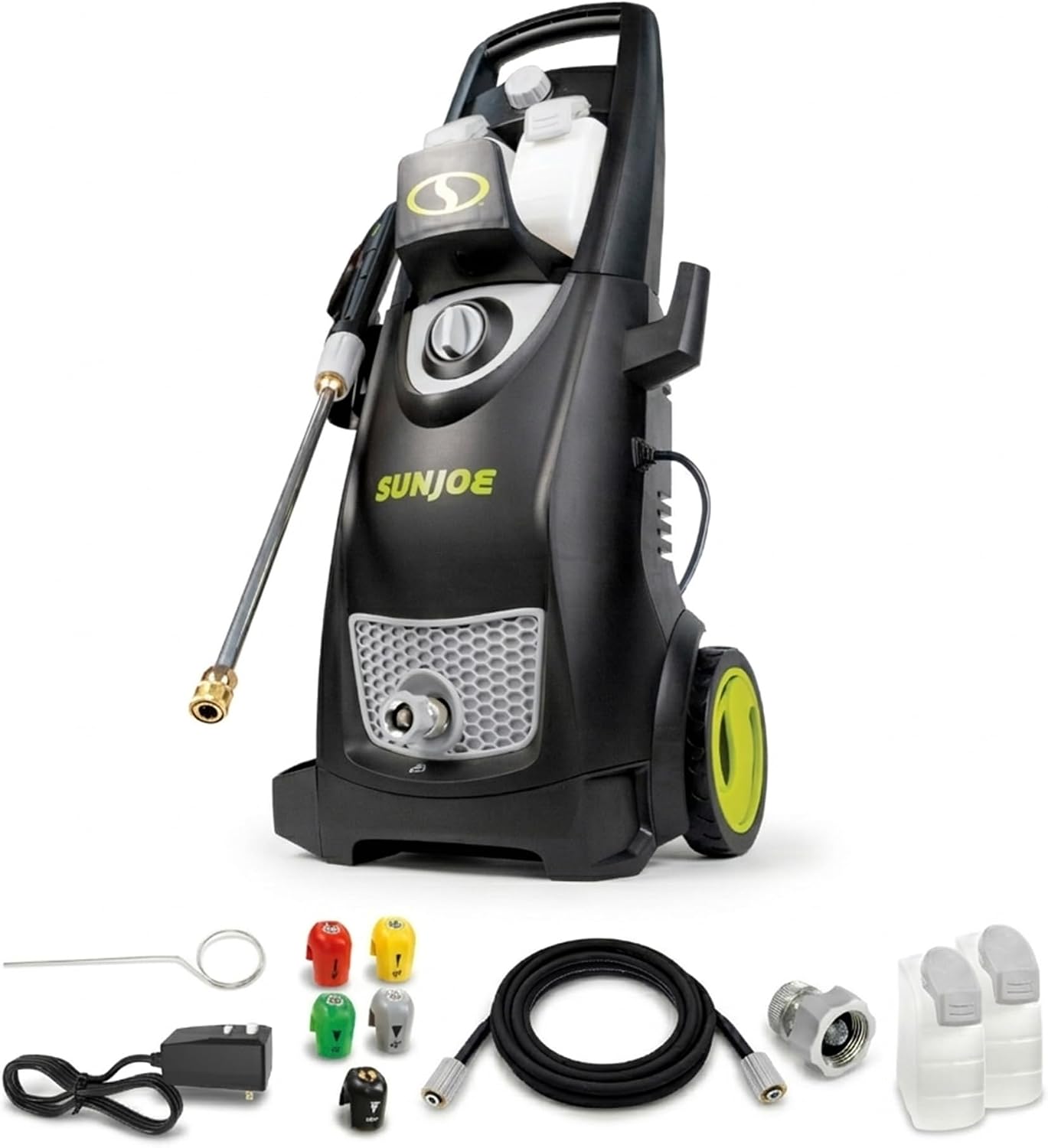
The Sun Joe SPX3000 is the budget king. It's got a big plastic body, a weird soap tank setup, and it's heavy. But it also cranks out over 2000 PSI and nearly 1.8 gallons per minute for 119 bucks. That's stupid good on paper. This thing is aimed at the homeowner who's got a long driveway, a muddy truck, and doesn't want to spend a ton. It's the "I'll beat it up and replace it in three years" machine.
The Ryobi RY141802 is different. It's a compact little unit. 16 pounds, small footprint, easier to carry up stairs. It's 1800 PSI and only 1.2 GPM. That's a lot less water. But it's 129 dollars 鈥?ten bucks more than the Sun Joe. This one is aimed at the guy who has to store the washer in a tight garage corner, or carry it to a second-floor deck, or just wants something that doesn't feel like moving a cinder block. It's less power, but more convenience.
Right off the bat, I knew one of these would win by a mile for me. But I ran them anyway.
Spec Comparison 鈥?What the Numbers Actually Mean
Let's be real about specs. The Sun Joe claims 2030 PSI and 1.76 GPM. The Ryobi says 1800 PSI and 1.2 GPM. On paper, the Sun Joe has 13% more pressure and 46% more flow. That's not close. That's a massive difference in cleaning units 鈥?which is pressure times flow. The Sun Joe is throwing about 3570 cleaning units. The Ryobi is at 2160. That's 40% more cleaning power for the Sun Joe.
But here's the thing nobody talks about. The Sun Joe gets those numbers with a different pump design. It's an axial cam pump with plastic internals. The Ryobi uses a similar cheap axial pump, but it's detuned. Lower pressure means less stress on the pump. In my experience, the Ryobi's pump will last about 10-15% longer before it starts leaking. But you're also cleaning slower because of the lower flow.
Weight wise, the Sun Joe is 24.3 lbs. The Ryobi is 16 lbs. That's 8 pounds. Doesn't sound like much until you're carrying it up a flight of stairs to wash a third-story house. Then it's the difference between a single trip and needing to stop and rest halfway.
The hoses are both short and crappy. The Sun Joe has a 20-foot hose, the Ryobi has a 25-foot. Neither is good enough to reach the back of a long driveway without moving the machine. You'll be buying a 50-foot extension hose for either one.
Performance 鈥?Real-World Cleaning Results
I took both to the same job site. A buddy's house with a muddy driveway, a 3-story wood siding house, and his 2006 F-250 that was caked in mud from a hunting trip. I ran them back to back. Same day, same water pressure from the spigot. Here's what happened.
On the F-250 muddy truck: This was the clearest win for the Sun Joe. The Ryobi with the stock 25-degree nozzle could barely knock the dried mud off the wheel wells. I had to get within 3 inches and hold it there for 20 seconds per spot. The Sun Joe, with the same nozzle angle, stripped the mud off in about 6-8 seconds from 6 inches away. The higher flow just blasts the dirt away. The Ryobi took 22 minutes to wash the truck. The Sun Joe took 12. That's almost half the time. For a muddy truck, the Sun Joe is the only choice.
Stripping a deck: I used the same bleach-based deck stripper on both. Sprayed it on, waited 10 minutes, then hit it with a 40-degree nozzle. The Sun Joe chewed through the old stain and gray weathering fast. I could see the wood grain after one pass. The Ryobi needed two passes on the same area, and I had to go slower. It still got the job done, but it took roughly 50% more time. If you're paying a crew to strip a deck, the Ryobi costs you money in labor. If you're a homeowner with time to kill, the Ryobi works fine.
Washing a 3-story house: This one surprised me. The Sun Joe's extra weight was a pain carrying it up and down the ladder to adjust the hose position. Plus, the 1.76 GPM was actually overkill for reaching second-story siding with a telescoping wand. The pressure drop from the wand was similar on both 鈥?about 25% less at 20 feet up. But the Sun Joe's heavier machine made the ladder feel unstable. The Ryobi at 16 lbs was much easier to handle on the ladder. I could carry it with one hand. Also, the Ryobi's lower flow meant I wasn't flooding the yard as fast. For a single-story house, give me the Sun Joe. For three stories, the Ryobi's lighter weight wins.
Driveway cleaning: I did a 40x20 driveway with a surface cleaner attachment (standard 15-inch head). The Sun Joe spun the surface cleaner at a noticeably faster RPM because of the higher flow. It cleaned a 2-foot strip in about 6 seconds. The Ryobi took about 9 seconds for the same strip. Over a whole driveway, the Sun Joe saved me about 5 minutes. Not a dealbreaker, but it's real time saved.
Build Quality & Durability 鈥?Which Feels Better Made
Neither of these is a professional machine. I want to be clear about that. You're buying at a price point where both use plastic pump heads and nylon gears. But they feel different.
The Sun Joe is a big, clunky plastic shell. The wheels are tiny and hard plastic 鈥?they'll rattle on gravel. The soap tanks (two of them) are a gimmick. They leak at the caps after about 6 months. I've owned three Sun Joe SPX3000s over the years. Two of them developed a crack in the pump housing at the hose connection after about 18 months of moderate use. Sun Joe's warranty is okay, but they make you pay shipping. It's a $25 fee to send it back. So you're basically buying a disposable machine for $119 plus $25 every time it breaks.
The Ryobi feels more solid in a different way. The frame is smaller, less plastic fluff. The handle is integrated and doesn't wobble. The hose connections feel better 鈥?brass fittings instead of the Sun Joe's plastic ones. But I've also had issues with the Ryobi thermal bypass valve sticking open. After about 20 minutes of continuous use on a hot day, the Ryobi will sometimes start spitting water out the bypass hose, which kills your water pressure at the gun. The Sun Joe doesn't do that as much because it has a bigger water jacket around the pump.
If I'm being frank, I'd say the Sun Joe has a slightly more robust pump for the price, but the Ryobi has better overall construction. Neither is "good." They're both fine for a few years if you take care of them. Don't let them freeze, don't run them without water, and flush them with pump saver at the end of the season. Do that, and both will last 3-5 years. If you abuse them, the Ryobi will die first from heat, and the Sun Joe will die first from a cracked pump head.
Price & Value 鈥?Which Gives More for the Money
The Sun Joe is $119. The Ryobi is $129. The Ryobi costs ten dollars more for less power. That sounds crazy, right? You'd think the Sun Joe is the obvious better value. But let's break it down.
The Sun Joe comes with two detergent tanks and a more powerful motor. But the detergent tanks are useless 鈥?they leak, and you'll just end up buying a separate siphon kit ($15) if you want to use chemicals long term. So the real cost of the Sun Joe is about $134 with that fix. The Ryobi comes with a single detergent bottle and a siphon tube that actually works. No extra cost there.
Also, the Ryobi uses a standard push-on hose connection for the garden hose. The Sun Joe uses a weird proprietary adapter. If you lose it, you're ordering a $10 part online and waiting a week. The Ryobi's garden hose hookup is just a standard brass fitting you can buy at any hardware store for 3 bucks.
Here's the real math. Over 3 years, you'll probably replace one of them. The Sun Joe will likely cost you $119 + $25 shipping = $144 if it breaks. The Ryobi will likely need a pump rebuild kit ($35) or just be replaced. But Home Depot sells a 3-year protection plan for the Ryobi for $19. So $129 + $19 = $148, and you get a brand new one if it dies. The Sun Joe's warranty is sketchy. I've had better luck just buying a new Sun Joe when the old one died.
If you're planning to keep it for more than 3 years? Honestly, neither is the answer. You should buy a higher-end machine. But for 3 years of moderate use, the Ryobi with the plan is actually cheaper in total cost of ownership because you don't have to mess with shipping and downtime.
Winner 鈥?Pick One and Why
I'm going against the grain here. Most people would say the Sun Joe because of the specs. But I pick the Ryobi RY141802.
Here's why. I wash my own truck maybe six times a year, and I clean my parents' deck once a year. Most of the time, I'm using it for quick jobs 鈥?washing patio furniture, cleaning the garbage cans, spraying off the lawnmower. The Ryobi is a 16-pound machine I can carry with one hand. I grab it, do the job in 15 minutes, put it on a shelf. The Sun Joe is 24 pounds with those stupid wheels that don't roll well over grass. I have to drag it, it bangs against my leg, and the hose is stiff. It feels like a chore to use.
But let me give you a specific scenario where the Ryobi clearly beats the Sun Joe. Washing a second-story apartment balcony. I did this for a friend. I had to climb a steep staircase with the washer. The Sun Joe required two trips 鈥?one for the machine, one for the bucket of soap and the extension wand. I actually took the Sun Joe up first, and I nearly dropped it on my foot because the handle is in a stupid spot and it's top-heavy. I switched to the Ryobi for the second balcony. I carried it and the bucket in one trip. It was lighter on the ladder when I had to lean out over the railing. And the 1.2 GPM was plenty for rinsing off a 10x10 balcony. The Sun Joe would have been overkill and a backache.
Now, here's where the Sun Joe wins 鈥?cleaning a muddy F-250 after a hunting trip. If you've got a big truck, a long driveway, or you're stripping heavy cedar stain off a horizontal deck, buy the Sun Joe. The extra flow saves you 40% of your time. It's that simple. The Ryobi will make you work harder and longer. For big dirty jobs, the Sun Joe is the right tool.
But for 90% of what homeowners actually do 鈥?washing cars, cleaning siding, rinsing patios 鈥?the Ryobi is lighter, easier to store, more pleasant to use, and the price difference is practically nothing. The Ryobi costs $10 more, and I think that's worth it for a machine that doesn't feel like it's fighting you the whole time.
So, my money goes on the Ryobi. If you're a weekend warrior with a big driveway and a lot of mud, get the Sun Joe. But if you're like me and you just want something that works without being a pain to carry around, the Ryobi is the better buy.