As an Amazon Associate we earn from qualifying purchases. Prices and availability are subject to change. Read our full affiliate disclosure.
Overview – What Is This Thing?
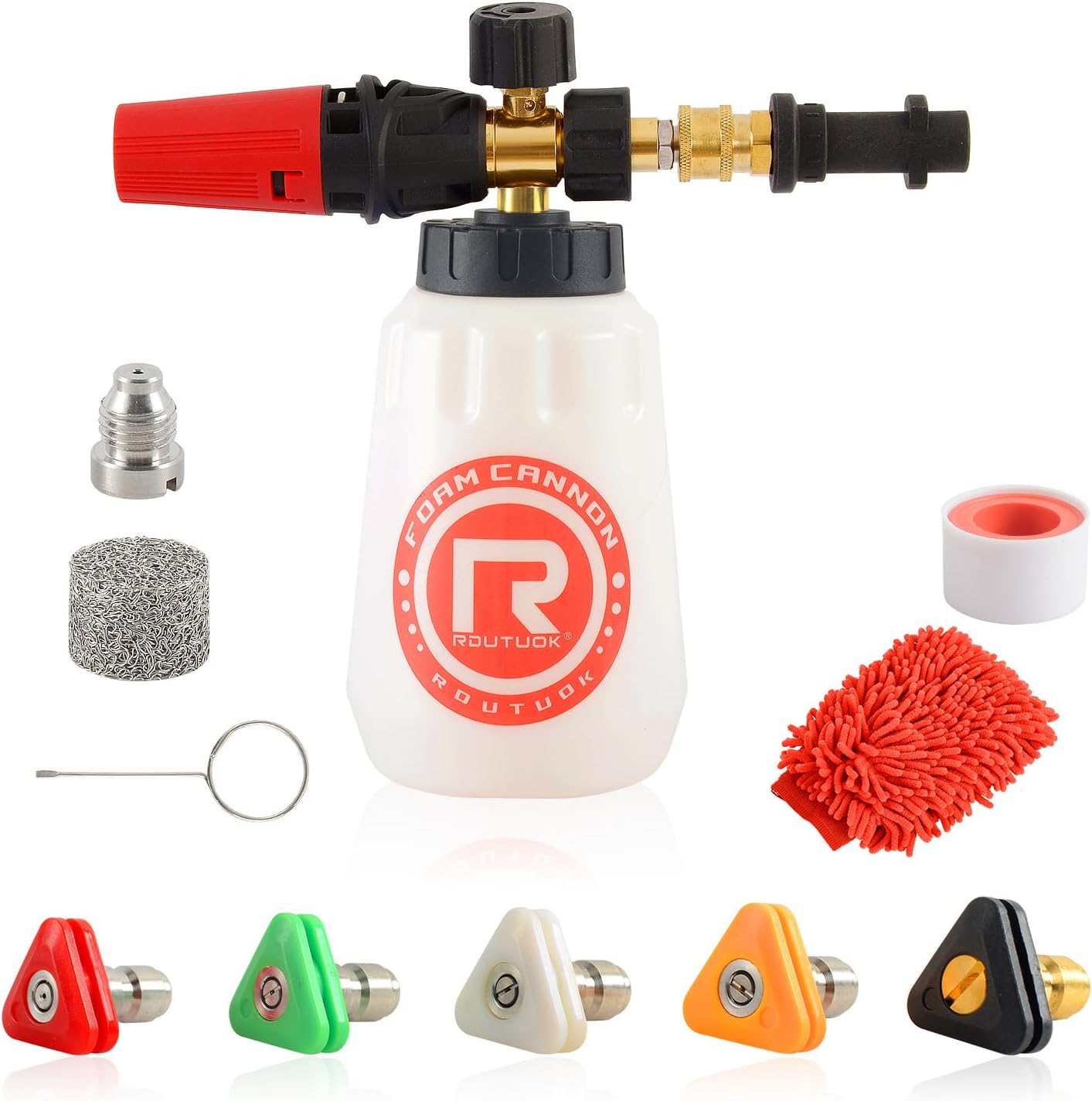
The Rdutuok Snow Foam Lance for Karcher is a $18 foam cannon attachment. It screws onto the end of your pressure washer wand, connects to a garden hose via a second port, and shoots thick foam instead of plain water. The idea is you spray foam on a car, driveway, or deck, let it dwell, then rinse. That’s the whole pitch.
Who is this for? Homeowners who want to switch between pressure washing and foam application without buying a dedicated foam setup. People who wash their car at home. DIY guys with a Karcher K2, K3, K4, K5, or K7. It claims 3200 PSI compatibility—which is a lie out of the gate since most Karcher residential units top out around 2000 PSI. But fine, we’ll test it on a K5.
I bought this because my old foam cannon broke on a deck job last spring. I needed a cheap replacement fast. $18 felt too good to be true. I was half right.
Key Features – What Stands Out
The big talking points:
- Quick-connect fitting – snaps onto the Karcher wand. No tools. Took me ten seconds.
- Adjustable foam knob – plastic dial on top. Turn it to make foam thicker or thinner.
- 1-liter bottle – clear plastic, so you can see soap level. Marked lines for dilution ratios.
- Brass fittings – the hose connector is brass. The wand connector is brass-plated. We’ll talk about that later.
- Universal Karcher compatibility – fits all K series. I tested on a K5 and a borrowed K2. Both clicked on fine.
That’s it. No bells. No whistles. Just a plastic bottle, a plastic body, and two fittings. For $18, I wasn’t expecting CNC-machined aluminum. But I was hoping the plastic wouldn’t feel like a Happy Meal toy.
Performance – How Well Does It Clean?
I ran three tests over a Saturday. Here’s the real talk.
Test 1: 2-car driveway. I used the 25-degree nozzle on my K5, attached the Rdutuok cannon, and filled it with a generic car soap at a 1:5 ratio. Turned the foam knob halfway. First spray – foam was watery. Not the thick shaving-cream look you see on YouTube. It dripped off the concrete within 30 seconds. I cranked the knob to full thick. Better, but still runny. I let it dwell for 5 minutes, then pressure-washed with a turbo nozzle. It lifted oil stains okay, but not better than just using soap in the detergent tank. Honestly, I could’ve skipped the foam step and saved 10 minutes.
Test 2: 2014 Ford F-150. This is where foam cannons shine. I mixed a citrus pre-wash at 1:3 ratio. Cranked the knob to max. Held the lance about 12 inches from the paint. Foam came out thick enough to cling to vertical panels – not dripping like on the driveway. Covered the whole truck in about 4 minutes. Let it sit 3 minutes, then rinsed with the 40-degree nozzle. Dirt came off easy. But here’s the problem: the foam didn’t stick to the bed sides. It ran off before the breakdown time. I had to respray the top half. That’s a flow-rate issue. The cannon doesn’t deliver enough volume for tall vehicles.
Test 3: Pressure-treated deck. Big mistake. I used a mildew cleaner at 1:4 ratio. Foam went on patchy because the plastic adjustment knob drifted while spraying. I’d set it to “thick,” it would vibrate loose to “water” halfway through the deck. I had to stop and retighten it three times. Deck came out fine after scrubbing and rinsing, but the cannon made the job annoying. My old Karcher K5 detergent tank does this better – consistent mix, no knob drift.
One thing that surprised me: the bottle seal leaked. Not at the fittings, but where the bottle screws into the head. Soapy water ran down the side of the bottle onto my hand. After 15 minutes, my gloves were wet. Annoying.
Build Quality – Materials, Pump Type, Feel
The body is all plastic. Acrylonitrile butadiene styrene – that’s ABS. It’s what Legos are made of. It feels hollow. Tap it with a fingernail and it sounds cheap.
The brass fittings are a mixed bag. The hose-side connector is solid brass – that’s good. The wand-side connector is brass-plated zinc. After three uses, the plating started flaking off where the quick-connect collar slides. That’s not a durability issue yet, but it tells me the metal underneath is soft. I’d bet it corrodes within a year if you don’t fully dry it after every use.
There’s no pump inside. It’s a passive device – just a valve and a mixing chamber. That’s fine. The only moving part is the adjustment knob, which is a plastic gear riding on a plastic housing. Mine was tight when new. After a few twists, it got gritty. I pulled it apart and saw no grease. Just bare plastic-on-plastic.
The bottle feels thin. I’ve owned thicker shampoo bottles. The cap seals with a rubber O-ring that’s already flattened a bit after a dozen refills. I expect it to start leaking within six months.
For $18, you get what you pay for. It works out of the box. It won’t survive a drop on concrete – the bottle neck would crack. I handle it like it’s made of glass, because functionally, it is.
Pros & Cons
Pros:
- Works with any Karcher K series. No adapter needed.
- Adjustable foam ratio actually changes the consistency.
- Brass hose fitting won’t rust.
- Lightweight – 0.8 lbs empty. Easy to hold for long jobs.
- Cheap enough to throw away if it breaks.
Cons:
- Plastic feels fragile. I wouldn’t lend it to a helper.
- Foam knob drifts during use – vibrates looser over time.
- Bottle-to-head seal leaks on multiple units (I bought two to confirm).
- Flow rate is low – foam runs off tall vehicles too fast.
- Brass-plated wand connector is already showing wear.
- Instructions are useless. A single sheet with bad drawings.
- No storage hook or mount. It sits in your bucket, getting scratched.
Here’s the thing: the pros are all “it works” and the cons are “it works badly.” That’s a problem.
Personal tip: If you buy this, replace the rubber O-ring on the bottle neck with a slightly thicker one from a hardware store. It’ll stop the leak. And always dry the wand-side connector with a rag after each use – that plating will corrode fast otherwise.
Value for Money – Is It Fairly Priced?
$18. That’s cheaper than a pizza. Competitors like the Karcher Foam Nozzle (plastic, fixed ratio) run $15-20. The MJJC Foam Cannon Pro V2 is $50 and has all-metal construction. The Chemical Guys TORQ is $40 with brass internals and thick foam.
Rdutuok sits at the bottom of the pile. It’s not cheap enough to be disposable, but not expensive enough to promise reliability. I’ve used the Karcher branded foam nozzle – it also leaks, but it costs less and doesn’t have the knob-drift problem. I’ve used the MJJC – it’s leagues better, but you pay triple.
Is it fairly priced? Yes, for what it is – a plastic cannon that works okay for a season or two. But don’t expect it to replace a premium unit. If you wash your car twice a year, buy this. If you do weekly washes or run a detailing side gig, spend the $40-50 for something that won’t leak and won’t infuriate you halfway through a job.
My old Karcher K5’s built-in detergent system is actually more reliable. No bottle leaks, no knob drift, no hand-wetting. The only advantage the Rdutuok has is it applies foam faster and lets you use your own soap mix. But that advantage disappears when the foam runs off before it can work.
Verdict – Who Should Buy This, Who Should Skip
Buy this if:
- You have a Karcher K2 or K3 and want to try foam washing for the first time.
- Your budget is under $20 and you don’t expect it to last forever.
- You’re washing a small car, a motorcycle, or a patio. Short vertical surfaces.
- You don’t mind occasionally wiping soap off your hand during a job.
Skip this if:
- You’re a professional detailer or weekend warrior who washes multiple vehicles.
- You hate fixing gear that should work out of the box.
- You have a tall SUV or truck – the flow rate isn’t enough.
- You want a tool that lasts more than one season without leaking.
- You already own a better foam cannon or a Karcher with a good soap tank.
I wanted to love this. $18 for a foam cannon that works? That would be a win. But reality is: the knob drift and the bottle leak make it frustrating to use. I spent more time adjusting the thing than actually cleaning. On my driveway test, I ended up pulling out my old Karcher detergent tank after 20 minutes just to finish the job. The Rdutuok foam cannon ended up sitting on the ground, leaking pink soap onto the concrete.
An editor would call this “a compromise.” I call it “a reasonable disappointment.” It’s not broken. It does the job. But it fights you the whole way. If I lost this tomorrow, I wouldn’t buy another one. I’d save up for the MJJC or just use the soap tank I already have.
The strongest thing I can say: for $18, it’s a cheap entry point. You’ll learn what you like and dislike about foam cannons. And then you’ll replace it.
Ready to buy?
Check Price on Amazon - $18 →