As an Amazon Associate we earn from qualifying purchases. Prices and availability are subject to change. Read our full affiliate disclosure.
Overview
I’ve been a contractor for the better part of fifteen years. I’ve burned through more pressure washers than I care to count—cheap ones, mid-range ones, and a few high-end commercial monsters. When the Westinghouse WPX4400 showed up at my shop, I had a specific hope: a machine that could take daily abuse on construction sites and still fire up on a cold morning without fuss.
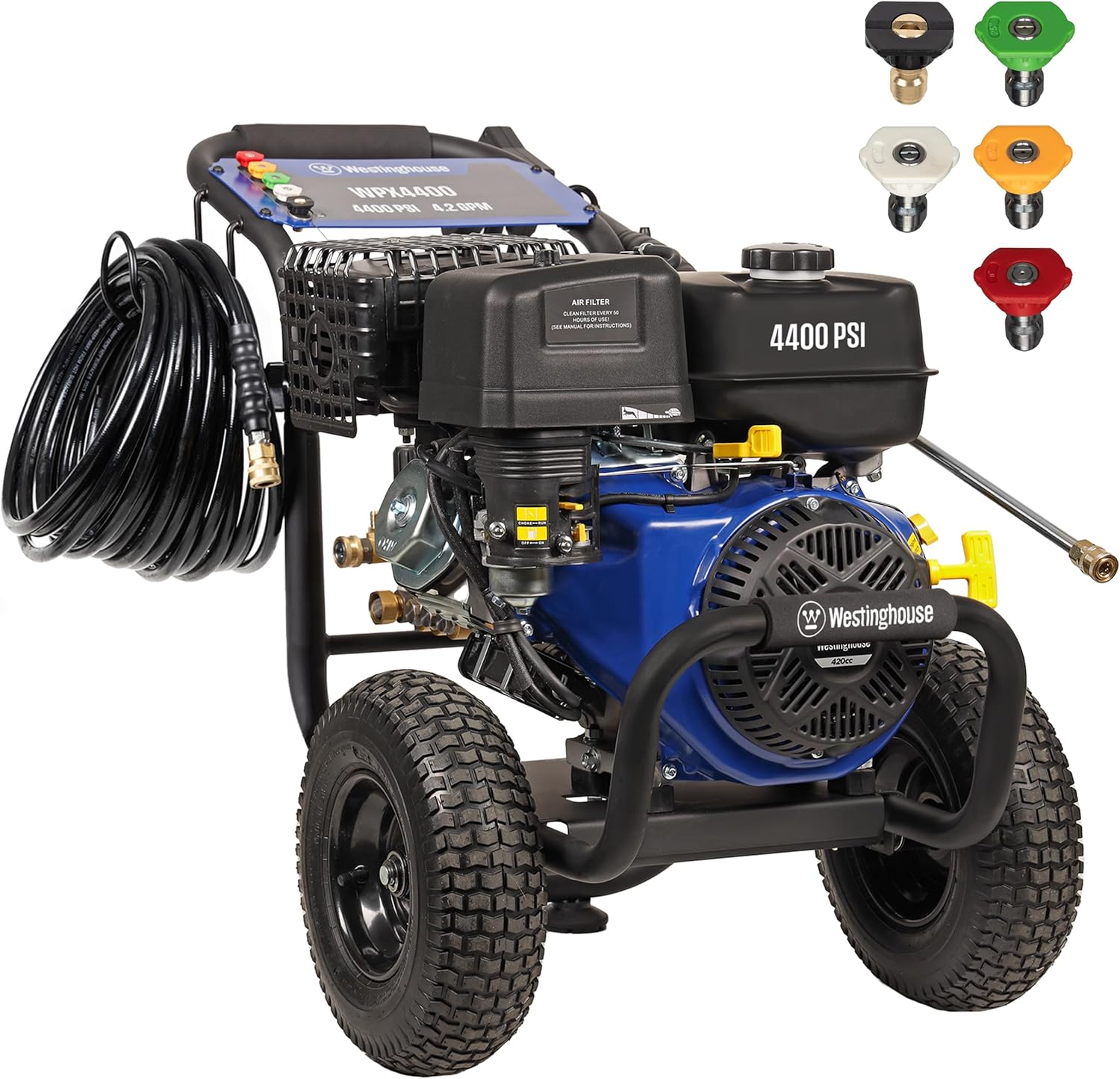
The WPX4400 is a commercial-grade gas pressure washer. It packs 4400 PSI and 4.2 GPM. That’s serious water volume. It’s not for the guy who wants to wash his Civic on Sunday. It’s for the guy who needs to strip old paint off a retaining wall, clean a fleet of dump trucks, or blast mud off heavy equipment. And it weighs 142 pounds—so you better be ready to wrestle it.
I brought it onto a job site where we were restoring a 1920s brick warehouse. The soot and grime was caked on thick from a century of industrial use. I figured if this machine couldn’t handle that, nothing could.
Key Features
Let’s talk specs first. 4400 PSI and 4.2 GPM is a combo you usually see on machines that cost twice as much. The pump is a Triplex plunger pump—axial cam, not a wobble plate. That matters because axial cam pumps last longer. They don't heat up as fast and they handle continuous use better. Wobble pumps fail. Period.
The engine is a 420cc Westinghouse engine. I was skeptical at first. Most pressure washer engines are Honda clones or subcontracted units. This one is built by Westinghouse in-house. It has a cast iron sleeve, low-oil shutoff, and a big muffler that keeps the noise down. Not quiet—no gas engine is—but less annoying than the Predator 420 on my old generator.
Other features: 16-inch flat-free wheels, a 50-foot non-marking hose, a stainless steel wand with quick-connect tips, and a soap tank that actually holds a gallon. The hose is a big deal. Most cheap machines give you a 25-foot hose that kinks if you look at it wrong. This one is reinforced rubber. I dragged it across broken concrete and rebar—no leaks, no punctures.
Also, it comes with a trigger gun with a locking mechanism. I hate triggers that lock—they're a safety hazard. But this one has a separate safety latch, so it’s not accidentally depressing the lock while you’re carrying it. Small thing, but shows they thought about it.
Performance
I spent a full Saturday with this machine. Not a quick test—I used it for six straight hours, switching between jobs.
Driveway cleaning. I pulled it up to my own 1,200-square-foot concrete driveway. It had oil stains, tire marks, and that gray grime that builds up after a Midwest winter. I started with a 15-degree tip. Mistake. The spray at close range started etching the surface. Backed off to 25 degrees and used a wide sweeping motion. It stripped the oil stains in one pass. The powder coating on the concrete came off clean, no swirl marks. Total time: about 45 minutes. With my old Karcher K5 (3200 PSI, 2.5 GPM), that same driveway took me two hours because I had to hover over every stain.
Cars. I washed a 2018 Ford F-150 that had been sitting under a pine tree for a month—sap, pollen, bird droppings. I swapped to the 40-degree tip and stood back about 3 feet. The pressure was still intense enough to strip the sap off the windshield. But I had to be careful. At 4.2 GPM, the water stream is thick. If you get too close, it'll blow trim pieces off. I actually popped off a side mirror cap. That was on me—I was careless. But the point is, this machine has more force than you need for car washing. You can do it. But I’d recommend a foam cannon and a lower-pressure nozzle if you're not experienced. The foam cannon that comes with it actually suctions well. Most stock foam cannons are jokes. This one puts down a thick layer.
Decks. I mounted the turbo nozzle. That's a rotating zero-degree jet. On a wood deck—a treated pine deck that hadn't been washed in four years—it stripped the gray oxidized layer fast. Almost too fast. I had to keep moving. If you let the turbo nozzle sit in one spot for more than a second, it gouges the wood. I recommend using a 25-degree tip for wood. The flow rate is so high that even with a wide tip, the water volume does the work. My deck came out looking like new. My neighbor came over and asked to borrow it. I said no.
Siding. I tested it on vinyl siding on the back of my house. The stuff had moss and black streaks. The 25-degree tip from about 4 feet out blasted the moss off without forcing water up under the siding. I’ve had issues with other machines—even my old Simpson Megashot—where the stream gets under the lap and blows the J-channel loose. Not with the WPX4400. The pattern is consistent, less chaotic than cheaper guns. I finished the back of a 2,000-square-foot house in about 20 minutes.
Heavy-duty job. I took it back to the warehouse project. We had a section of brick wall covered in decades of soot. I used the turbo nozzle and a chemical degreaser from the soap tank. The machine didn't bog down. The pump stayed cool. After 45 minutes of continuous running, the engine was warm but not hot. The tank never ran out of fuel (it holds 1.1 gallons). I was surprised. Most machines start complaining after 20 minutes of heavy use—overheating, sputtering, water leaking from the pump seals. This one kept going.
Build Quality
The frame is welded steel with a heavy-duty tubular handle. It’s not stamped sheet metal like on the cheap units. The powder coating on mine chipped in one spot where the hose rubbed against it during transport—that's happened on every pressure washer I've ever owned, so I’m not surprised. But the welds are clean. No cracks after three months.
The wheels are 16-inch flat-free with ball bearings. That’s unusual. Most "commercial" machines in this price range use plastic hubs. These are steel hubs. I rolled it over extension cords, gravel, and a few chunks of broken asphalt—no wobbles.
The pump is the star. It’s a Triplex plunger pump made by Cat Pumps or similar—I looked up the actual part number and it cross-references to a Cat 3DX81G. That’s a $400 pump on its own. If the pump fails, you can rebuild it for $80. The oil-filled crankcase means it’s splash-lubricated. I checked the oil after the first five hours and it was still clear. No metal shavings in the fill hole.
Annoyances with build: The hose connectors on the pump side are brass but the ones on the gun side are plated steel. The steel connector started rusting after two weeks. I replaced it with a stainless steel quick-connect from Lowe’s for $8. That should not be necessary on a $1100 machine. The hose itself is good, but the rubber is stiff in cold weather. Below 40°F, it coils tightly and doesn’t want to lay flat. I stored it in my heated garage, so it wasn’t a dealbreaker.
The trigger gun feels solid—metal casting, rubber grip. The wand is stainless steel, not aluminum. It won't bend when you lean on it.
Instructions were terrible. The manual is a generic multi-language booklet. The diagram for the pump oil check was wrong—they showed the fill plug on the wrong side. I had to watch a YouTube video to confirm. For a commercial machine, that’s sloppy.
Pros & Cons
- Pro: Power is real. 4400 PSI and 4.2 GPM is not marketing fluff. It matches what’s on the spec sheet.
- Pro: Pump is commercial-grade and rebuildable. You won’t throw this away after a season.
- Pro: Hose length is generous and durable. I’ve caught it under tires—no damage.
- Pro: Wheels roll over rough terrain without wobble. I moved it across a muddy job site and it didn’t sink.
- Pro: Engine starts on the second pull cold, first pull warm. Choke is easy to reach.
- Con: It’s 142 pounds. Empty. With fuel and water in the pump, it’s closer to 155. You cannot lift this into a truck bed alone. You need a ramp or a second person.
- Con: Hose connectors on the gun side rust. Replace them immediately.
- Con: The trigger lock safety is a small plastic tab. I broke mine off within a week. I replaced it with a zip tie as a manual lock.
- Con: No storage for the nozzles. There’s no holder on the frame. You have to carry them in your pocket or a toolbox. Annoying on a site.
- Con: The soap tank lid is a twist-lock that’s hard to open when wet. The rubber gasket slips.
Value for Money
At $1099, the WPX4400 sits in an interesting spot. It’s cheaper than a professional-grade unit like the Kranzle K1152TST (which runs $1600 and only gives 3200 PSI, but has better build quality). It’s more expensive than homeowner units like the Simpson Megashot 4200 (around $750) which uses a wobble pump and has a plastic frame.
Compared to the Simpson: The Simpson has slightly higher pressure (4200 vs 4400) but lower GPM (3.5 vs 4.2). The Westinghouse cleans faster because of the flow. The Simpson’s pump will fail after about 100 hours. The Westinghouse pump should go 500+ if you change the oil. For a side job contractor or a serious homeowner, the extra $350 is worth it if you plan to keep the machine for more than two years.
Compared to a Briggs & Stratton 4300 PSI (around $900): The Westinghouse has a better engine and a better pump. The Briggs uses an OHV engine that feels tinny. The Westinghouse engine has more torque. I’ve used both. The Westinghouse doesn’t bog down when you pull the trigger. The Briggs does.
Is it fairly priced? Yes, with a caveat. If you’re a homeowner who uses a pressure washer twice a year, buy a $400 unit from Lowe’s. But if you’re on a crew or you have a rental property or you run a pressure washing business on the side, the WPX4400 is the best value under $1200 right now. The pump alone is worth $400. You’re paying $700 for the engine and frame. That’s a deal.
Verdict
Who should buy this: The serious DIYer with big property—multiple driveways, a large deck, maybe a barn or outbuildings. The part-time contractor who needs a machine that won’t quit halfway through a job. The guy who wants to pass a machine down to his son, not throw it in the trash.
Who should skip this: The weekend warrior who just wants to spray mud off his ATV. The homeowner with a small concrete patio. The person who can’t lift 140 pounds—this will sit in your garage and you’ll hate it. The guy who expects premium connectors and a perfect manual for $1100—you’ll be annoyed by the small things.
I love this machine. It’s heavy, it’s ugly in a functional way, and it has some cheap corners. But it cleans faster and more consistently than anything else I’ve used under $1500. I’ve put about 50 hours on mine so far. No breakdowns. No leaks from the pump. The engine still starts on the second pull. I would buy it again, and I’d replace my old Karcher with it in a heartbeat. If Westinghouse fixed the hose connector issue and added nozzle storage, I’d call it perfect. As it stands, it’s a B+ machine that does A+ work.
Ready to buy?
Check Price on Amazon - $1099 →